
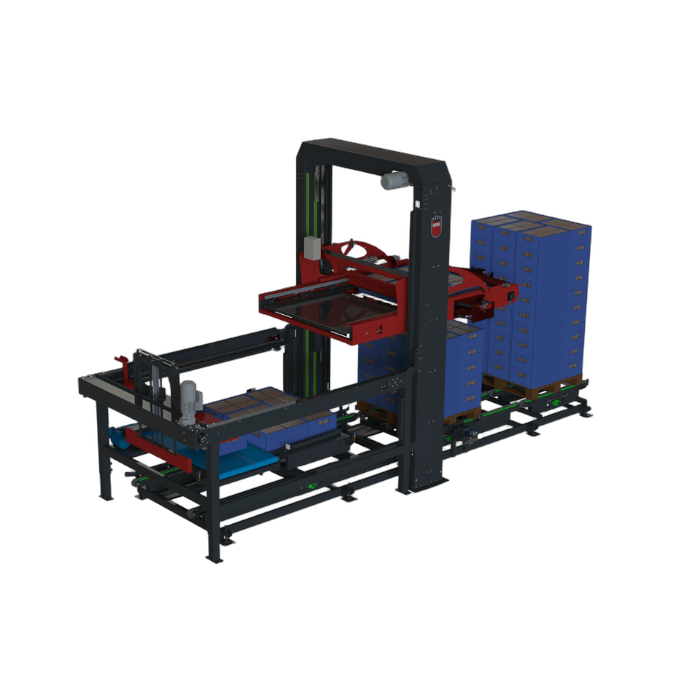

Key takeaways
| Factor | Guidance |
|---|---|
| Single-line system cost (AUD, 2026) | $80,000–$220,000 total project - one palletiser serving one production line |
| Multi-line system cost (AUD, 2026) | $150,000–$500,000+ total project - one or more palletisers serving multiple lines |
| Conveyor routing add-on (multi-line) | $30,000–$100,000+ depending on number of lines, buffer complexity and floor layout |
| Primary efficiency driver | Single-line: simplicity and uptime. Multi-line: capital efficiency and throughput consolidation |
| Failure risk | Single-line failure halts one line. Centralised multi-line failure halts all feeding lines simultaneously |
| SKU changeover | Single-line handles changeovers independently per line. Multi-line requires scheduling across all connected lines |
| Typical upgrade trigger | SKU count growth, floor space constraints, or capital budget pressure across multiple simultaneous lines |
Why buyers are comparing these configurations
Single-line and multi-line palletising aren't just different machinery choices - they're different operational architectures. The decision affects floor layout, conveyor infrastructure, how downtime propagates through a facility, and how changeovers are managed across multiple products. Getting the configuration wrong adds cost in ways that don't show up in an equipment quote: additional conveyor runs, buffer accumulation systems, programming complexity and the hidden cost of a single failure point that stops multiple production lines simultaneously.
Facilities evaluating this decision typically include:
- Food and beverage manufacturers running 2–5 production lines with separate SKU outputs
- FMCG packaging operations weighing capital efficiency against operational flexibility
- Pharmaceutical lines where product segregation and changeover traceability are compliance requirements
- Agricultural and bulk processing facilities consolidating multiple bag or carton lines into shared end-of-line infrastructure
Is this guide for you? If you're designing a new end-of-line palletising setup, expanding from one to multiple lines, or evaluating whether to centralise existing single-line palletisers - this guide gives you the configuration logic and cost data to make the right call. Browse verified Australian palletiser suppliers to compare system types and request quotes.
System configurations
| Configuration | How It Works | Best For |
|---|---|---|
| Dedicated single-line | One palletiser per production line - each line palletises independently | Multi-SKU operations, high changeover frequency, lines with different throughput rates |
| Centralised multi-line (robotic) | One robotic arm serves 2–4 converging infeed lines via shared conveyor routing | Similar-SKU lines, high capital efficiency requirement, facilities with space constraints |
| Hybrid | 2–3 palletisers each serving 2 lines - partial consolidation with distributed failure risk | Mid-size facilities balancing capital cost and operational resilience |
| Cobot single-line cells | Independent cobot palletiser per line - modular and relocatable | Low-volume lines, facilities adding automation incrementally |
Dedicated single-line systems give each production line autonomous palletising capability. A line stoppage affects only that line - the rest of the facility keeps running. Changeovers are managed per line without affecting adjacent operations. The trade-off is capital cost: each line requires its own palletiser, which at $80,000–$150,000 per robotic system adds up quickly across a multi-line facility.
Centralised robotic palletising systems consolidate infeed from multiple lines into a shared palletiser cell via conveyor merging and buffering. One robotic arm - with the right EOAT and pallet pattern programming - can serve 2–4 lines at moderate combined throughput. The capital saving is real: one $150,000 system instead of three $100,000 systems. The risk is equally real: a single palletiser failure stops all connected lines simultaneously.
Key specifications buyers should evaluate
| Specification | Single-Line Setup | Multi-Line Setup |
|---|---|---|
| Throughput requirement | Palletiser sized to individual line output - typically 8–20 picks/min | Palletiser must handle combined peak throughput of all feeding lines - buffer design critical |
| Conveyor infrastructure | Minimal - short infeed conveyor from line end to palletiser | Extensive - pallet conveyor merging, accumulation buffers, routing logic for multiple infeed streams |
| SKU changeover | Managed independently per line - no cross-line scheduling dependency | Requires sequenced changeover across all connected lines - programming and buffer management complexity increases |
| Floor footprint | Compact - palletiser and short conveyor run per line | Larger - centralised cell plus conveyor runs from each connected production line |
| Failure impact | Localised - one line affected per palletiser failure | Systemic - all connected lines stop on palletiser failure |
| Programming complexity | Lower - one pallet pattern set per palletiser | Higher - multi-SKU pattern library, line-priority logic, buffer management routines |
Technology or configuration options
| Factor | Dedicated Single-Line | Centralised Multi-Line |
|---|---|---|
| Equipment cost | $80,000–$150,000 per line | $150,000–$250,000+ for shared cell |
| Conveyor cost | $10,000–$30,000 per line | $30,000–$100,000+ for merged infeed routing |
| Total project cost (3 lines) | $270,000–$540,000 | $180,000–$350,000 |
| Failure impact | One line | All connected lines |
| SKU flexibility | High - per-line independence | Moderate - requires scheduling |
| Scalability | Add one line at a time | Adding lines increases buffer and routing complexity |
The capital efficiency case for centralised multi-line palletising is clear on paper - and it holds in practice when the lines running into a shared cell have similar throughput rates, compatible pallet patterns and manageable SKU changeover frequency. The case breaks down when lines run at different speeds, when changeover frequency is high, or when the facility cannot tolerate a single failure point stopping multiple lines simultaneously.
Robotic palletisers suit both configurations. In single-line setups, a dedicated robotic cell per line gives maximum operational independence. In multi-line centralised setups, the same robotic arm's programmability - switching pallet patterns via software rather than mechanical adjustment - is what makes serving multiple product streams viable.
Cobot palletiser cells are the most practical single-line option for lower-volume operations adding palletising incrementally. Their relocatable, fenceless design means cells can be redeployed as line configurations change - an advantage that centralised infrastructure can't match.
Costs in Australia
| Cost Component | Single-Line (per line) | Centralised Multi-Line (3 lines) |
|---|---|---|
| Palletiser equipment | $80,000–$150,000 | $150,000–$250,000 |
| Infeed conveyor | $10,000–$30,000 | $30,000–$100,000+ |
| Buffer accumulation system | Not required | $15,000–$40,000 |
| Safety guarding | $5,000–$20,000 | $10,000–$30,000 |
| Programming | $5,000–$15,000 | $10,000–$25,000 |
| Total project cost (3 lines) | $300,000–$645,000 | $215,000–$445,000 |
The centralised system carries a meaningful capital saving on a 3-line facility - typically $85,000–$200,000 less in total project cost. That saving narrows as SKU complexity and changeover frequency increase, and disappears entirely if a centralised failure event triggers multiple line stoppages requiring overtime recovery. Adding pallet wrapping machines downstream - which most operations require regardless of configuration - should be scoped and costed as part of the total project, not treated as a separate procurement.
Australian compliance requirements
- All palletising systems are classified as plant under the Work Health and Safety Regulations 2017 - risk assessment obligations apply regardless of configuration
- Industrial robotic systems require compliant safety guarding under AS 4024 - centralised multi-line cells typically require larger guarded zones than single-line installations
- Cobot cells operating in collaborative mode require documented risk assessment per ISO/TS 15066 - no fencing does not mean no compliance obligation
- Multi-line centralised systems integrating multiple conveyor infeeds require validated interlocking between all infeed lines and the palletiser cell
- All automated plant requires documented lockout/tagout (LOTO) procedures - multi-line systems require LOTO that isolates each infeed line independently
- Electrical installation must comply with AS/NZS 3000 and be completed by a licensed electrician
Supplier comparison checklist
| Factor | What to Ask |
|---|---|
| Throughput validation | What is confirmed throughput when all connected lines feed simultaneously at peak - not individual line maximum? |
| Buffer sizing | How is accumulation buffer sized for each infeed line, and what happens when one line runs faster than expected? |
| Failure protocol | What is the production impact of a palletiser fault, and what manual fallback is available while the system is down? |
| Changeover sequencing | How are multi-SKU changeovers managed across connected lines - who controls sequence and what is the changeover time penalty? |
| Conveyor scope | What conveyor infrastructure is included in the quote, and what site information is needed to price the full infeed routing? |
| Scalability | Can additional lines be integrated into the centralised cell without major redesign of the buffer and routing system? |
| Service coverage | Do you have engineers in my state with production-down response capability? |
| References | Can you provide references from similar multi-line configurations in my industry and SKU complexity? |
Frequently asked questions
Is a single-line or multi-line palletising setup more efficient? It depends on what you're optimising for. Single-line dedicated setups are more operationally efficient - faster changeovers, contained failure risk, and simpler programming. Centralised multi-line setups are more capital efficient - one system replacing three, with lower total project cost on comparable throughput. The right answer is determined by your SKU count, changeover frequency and tolerance for a shared failure point, not by throughput alone.
How much extra does conveyor infrastructure add for a multi-line system? Conveyor merging, accumulation buffering and routing logic for a 3-line centralised system typically add $30,000–$100,000 to the project cost above a single-line conveyor run. The exact figure depends on infeed distances, line heights and how many product streams need to be sequenced into a single palletiser cell. Always request a site-specific conveyor estimate - quoted conveyor costs based on floor plan assumptions rarely match installed costs.
What happens when a centralised palletiser goes down? All lines feeding into it stop - or accumulate until buffers fill, which buys minutes rather than hours. The practical mitigation is buffer accumulation system sizing and a service contract with guaranteed response times. For facilities where simultaneous multi-line downtime is unacceptable, dedicated single-line systems are the more resilient architecture regardless of capital cost. See the robotic palletiser maintenance guide for preventative maintenance scheduling that reduces unplanned failure risk.
Can one robotic palletiser realistically serve multiple production lines? Yes - with design constraints. A robotic arm serving 2–3 lines at moderate combined throughput (under 20–25 picks per minute total) is well within capability. Problems arise when combined throughput approaches the arm's rated limit, when SKU changeover frequency requires frequent reprogramming mid-shift, or when one line runs significantly faster than the others and creates buffer overflow. Always validate the throughput scenario at your specific product weights and changeover frequency - not at rated system maximums.
At what point does it make sense to add a second palletiser rather than centralise further? When the combined throughput of lines feeding a centralised cell approaches 80% of the palletiser's rated capacity, a second cell becomes worth evaluating - both for throughput headroom and failure risk distribution. A hybrid configuration (two palletisers each serving 2 lines) often delivers better operational resilience than a single centralised cell at lower additional cost than full single-line dedication across all lines.
Summary
- Single-line dedicated systems cost more across a multi-line facility but deliver superior operational resilience and changeover flexibility
- Centralised multi-line systems can save $85,000–$200,000 in capital on a 3-line facility - the saving is real when SKU complexity and changeover frequency are low
- Conveyor infrastructure is the most variable cost factor in multi-line design - always get a site-specific estimate, not a rule-of-thumb allowance
- A single centralised palletiser failure stops all connected production lines - buffer sizing and service response times are not optional considerations
- Cobot cells are the most flexible single-line option for incremental automation - they can be redeployed as line configurations change
- Hybrid configurations (2 palletisers serving 4 lines) often deliver the best balance of capital efficiency and operational risk distribution
Ready to compare palletising system configurations?
Don't waste time chasing individual suppliers. IndustrySearch gives you direct access to verified Australian palletiser suppliers - compare single-line and multi-line system options, specs and pricing in one place, then request quotes from suppliers best matched to your facility layout.
- Compare models - filter by capacity, configuration and region
- Request quotes - contact multiple verified suppliers with a single enquiry
- Contact suppliers directly - speak to specialists who service your state
→ Compare Palletisers on IndustrySearch Now





-205x205.jpg)
