

Key takeaways
- Palletising systems in Australia typically cost $40,000–$250,000+, depending on automation technology, production speed and system configuration.
- Collaborative robot palletisers usually cost $40,000–$80,000, making them the most accessible entry point for palletising automation.
- Industrial robotic palletisers generally range from $80,000–$150,000+, offering flexible palletising for multi-product production lines.
- High-speed layer palletisers can cost $150,000–$250,000+, designed for large packaging operations handling 25–40+ cases per minute.
- Total project costs often reach $80,000–$300,000+ once conveyors, guarding, programming and installation are included.
- Many palletising systems achieve ROI within 12–36 months through labour savings and increased packaging line efficiency.
- Manufacturers usually automate palletising when manual pallet stacking becomes a labour bottleneck or workplace safety risk.
Introduction
Palletising systems are automated machines used to stack cartons, bags, containers or packaged goods onto pallets for transport and storage. They are typically installed at the end of packaging lines, where finished products are prepared for shipment.
In many manufacturing facilities pallet stacking has traditionally been performed manually. However, as production volumes increase, manual palletising often becomes inefficient due to:
- labour shortages
- repetitive lifting injuries
- inconsistent pallet loads
- packaging line bottlenecks
Automated palletising systems solve these problems by stacking products consistently and at high speed, improving packaging line efficiency while reducing manual handling.
Industries commonly investing in palletising automation include:
- food and beverage manufacturing
- FMCG packaging
- pharmaceuticals and consumer goods
- logistics and distribution centres
- agricultural processing
For companies considering automation, the most common question is:
How much does a palletising system actually cost?
The answer depends on factors such as automation type, throughput requirements, payload capacity and integration complexity.
Palletising system price overview
The cost of palletising equipment varies depending on automation technology and production throughput requirements.
| Palletiser Type | Typical Price Range (AUD) | Typical Throughput |
| Collaborative robot palletiser | $40,000 – $80,000 | 6–10 picks/min |
| Robotic palletiser | $80,000 – $150,000+ | 10–20 picks/min |
| Layer palletiser | $150,000 – $250,000+ | 25–40+ cases/min |
| Fully integrated palletising line | $250,000 – $500,000+ | High-speed packaging lines |
These figures represent equipment costs only. The total project investment may increase once conveyors, safety guarding and integration are included.
When businesses invest in palletising automation
Manufacturers typically invest in palletisers when manual pallet stacking begins limiting production output.
Common triggers include:
- packaging lines exceeding 6–10 cartons per minute
- difficulty hiring labour for repetitive stacking tasks
- workplace safety risks from manual lifting
- inconsistent pallet load stability during transport
- expansion of production capacity
Many small manufacturers initially install collaborative palletising robots, which require lower investment and simpler installation.
Larger facilities often implement industrial robotic palletisers or high-speed layer palletising systems capable of supporting higher throughput.
Manual vs automated palletising
Businesses evaluating palletising automation often compare manual stacking with automated systems.
| Factor | Manual Palletising | Automated Palletiser |
| Labour requirement | 2–3 workers | 1 operator |
| Consistency | Variable pallet quality | Highly consistent |
| Production speed | Limited by labour | Matches packaging line speed |
| Workplace safety | Higher lifting risk | Reduced manual handling |
| Operating cost | Ongoing labour cost | Lower long-term cost |
Manual palletising may still work for very low production volumes, but automation becomes more cost-effective as throughput increases.
Palletiser types and cost differences
Different palletising technologies vary significantly in speed, flexibility and system cost.
Collaborative robot palletisers
Collaborative palletising robots (cobot palletisers) are designed for small to medium production environments.
Typical cost: $40,000 – $80,000
Key characteristics:
- compact installation footprint
- simplified programming
- lower capital investment
- moderate palletising speeds
Common applications:
- small manufacturing plants
- contract packaging operations
- food processing facilities
Industrial robotic palletisers
Industrial robotic palletisers use six-axis robotic arms equipped with specialised grippers to handle products.
Typical cost: $80,000 – $150,000+
Advantages:
- flexible product handling
- programmable pallet patterns
- ability to palletise multiple product types
These systems are widely used in FMCG manufacturing, beverage production and logistics facilities.
Layer palletisers
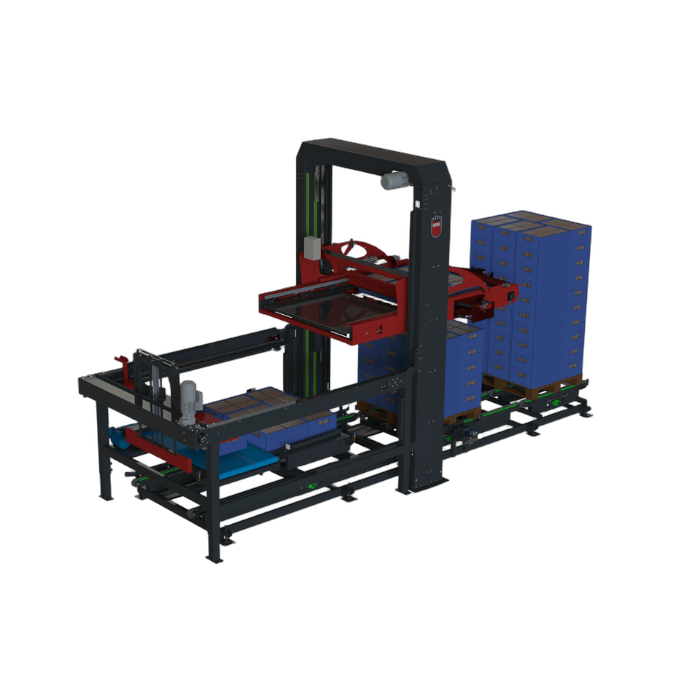
Layer palletisers stack entire product layers simultaneously, rather than individual items.
Typical cost: $150,000 – $250,000+
Key advantages:
- extremely high throughput
- stable pallet loads
- efficient handling of uniform packaging formats
Layer palletisers are commonly used in large beverage bottling plants or high-output packaging lines.
Example palletising system configurations
Real palletising projects often include multiple components.
| System Type | Typical Total Investment |
| Cobot palletiser cell | $60,000 – $120,000 |
| Robotic palletiser system | $120,000 – $220,000 |
| High-speed palletising line | $250,000 – $500,000+ |
Typical system components include:
- palletiser equipment
- product infeed conveyors
- safety guarding
- robot gripper tooling
- system programming
- installation and commissioning
Total palletising system cost breakdown
The total project cost of installing a palletiser often exceeds the equipment price alone.
| Cost Component | Typical Cost Range |
| Palletiser equipment | $40,000 – $250,000+ |
| Conveyors and infeed systems | $10,000 – $60,000 |
| Safety guarding | $5,000 – $25,000 |
| System programming | $5,000 – $20,000 |
| Installation and commissioning | $5,000 – $20,000 |
| Operator training | $1,000 – $5,000 |
Typical total project cost: $80,000 – $300,000+.
Integration costs vary depending on system complexity, facility layout and packaging line configuration.
Gripper and tooling options
Robotic palletisers use end-of-arm tooling (EOAT) to pick and place products.
Common gripper types include:
| Gripper Type | Typical Application |
| Vacuum grippers | cartons, boxes |
| Clamp grippers | beverage cases |
| Fork grippers | bagged products |
| Multi-product grippers | mixed packaging lines |
More complex grippers capable of handling multiple product formats can increase system cost but improve flexibility.
Typical ROI for palletising automation
Many manufacturers implement palletisers to reduce labour costs and improve packaging line productivity.
Example scenario:
| Factor | Manual Operation | Automated Palletiser |
| Operators required | 3 workers | 1 operator |
| Annual labour cost | $180,000 | $60,000 |
| Palletising output | Variable | Consistent |
In this scenario a $150,000 robotic palletiser could achieve payback within 18–30 months.
Additional benefits include:
- reduced workplace injury risk
- improved pallet load stability
- increased packaging line uptime
Key technical specifications
| Specification | Typical Range |
| Throughput | 6–40+ cases/min |
| Payload | 10–200 kg |
| Pallet height | Up to 2.2 m |
| Robot reach | 1.2–3 m |
| Footprint | 6–40 m² |
Which palletiser type is best for your production line?
| Production Volume | Recommended System |
| Under 10 cases/min | Cobot palletiser |
| 10–20 cases/min | Robotic palletiser |
| 25+ cases/min | Layer palletiser |
Selecting a palletiser that matches packaging line speed is critical to avoid production bottlenecks.
Common industry applications
Food and beverage manufacturing
Used to palletise packaged food, bottled beverages and canned products.
FMCG production
Common for stacking consumer goods cartons and retail-ready packaging.
Logistics and distribution
Automated palletising helps distribution centres prepare outbound freight shipments.
Agricultural processing
Palletisers are used to stack fertiliser bags, grain products and animal feed.
Common buying mistakes
Choosing a system that cannot match production speed
If palletisers cannot keep up with packaging lines they create bottlenecks.
Ignoring product handling requirements
Different packaging types require specialised grippers and pallet patterns.
Underestimating integration costs
Businesses often overlook conveyor and integration costs.
Overlooking future production growth
Packaging lines frequently increase speed over time. Selecting scalable automation avoids costly upgrades.
FAQ
How much does a palletising system cost in Australia?
Most palletising systems cost $40,000–$250,000+, depending on automation technology and throughput.
What is the cheapest palletising solution?
Collaborative palletisers are typically the lowest-cost option at $40,000–$80,000.
What industries use palletisers?
Food manufacturing, FMCG production, logistics distribution and agriculture.
How fast are palletising systems?
Typical speeds range from 6 picks/min (cobot) to 40+ cases/min (layer palletisers).
Conclusion
Palletising systems are an essential component of modern packaging operations, allowing manufacturers to stack products efficiently and consistently.
Costs vary depending on automation type, production speed and system integration requirements. Smaller facilities may benefit from collaborative palletising robots, while larger operations often require high-speed robotic or layer palletisers.
Evaluating throughput requirements, product formats and facility layout helps manufacturers select palletising equipment that delivers long-term operational value.
Compare palletiser suppliers on IndustrySearch
Before investing in palletising automation, many manufacturers compare multiple suppliers to ensure the system matches their production speed, product formats and integration requirements.
On IndustrySearch, businesses can request quotes from verified palletiser suppliers and compare:
- Palletiser system types (robotic, cobot and layer palletisers)
- Throughput capacity and payload specifications
- Integration with conveyors, case packers and packaging lines
- Installation, commissioning and engineering support
- Safety guarding and compliance features
- Maintenance services, spare parts and warranty coverage
Requesting multiple quotes helps procurement teams evaluate equipment capabilities, total project costs and implementation timelines before committing to a supplier.
According to IndustrySearch listings, palletiser systems in Australia commonly range from $30,000 to over $150,000 for equipment alone, with higher costs for fully integrated automation lines.
Comparing suppliers allows manufacturers to identify palletising systems that deliver the best combination of automation capability, engineering support and long-term reliability for their production environment.
```






-205x205.jpg)