
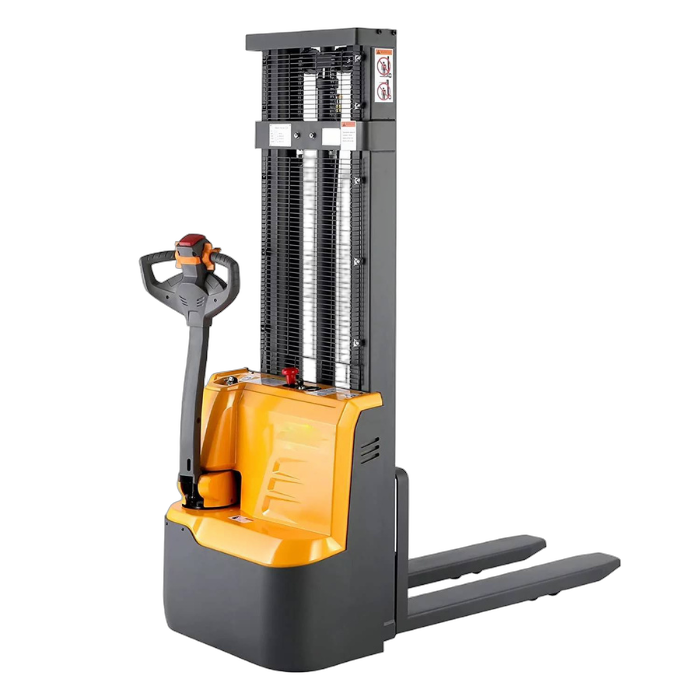

Key takeaways
| Factor | Walkie Stacker | Electric Pallet Stacker |
|---|---|---|
| Primary function | Stacking and retrieval to racking height | Lifting and short-distance pallet movement |
| Lift height | 2.5–5.5 m | 1.5–3.0 m (most models) |
| Lift capacity | 1,000–2,000 kg | 500–1,500 kg |
| Price range (new) | $4,500–$35,000 AUD | $2,500–$12,000 AUD |
| Annual running cost | $1,500–$4,500 | $800–$2,500 |
| Licence required | No — competency training only | No — competency training only |
| Aisle width required | From 1,800mm | From 1,500mm |
| Best for | Racking operations, medium-volume warehouses | Low-level lifting, staging, loading dock work |
Pricing reflects 2026 Australian market conditions.
→ Compare walkie stackers or electric pallet stackers on IndustrySearch to see current models and pricing from verified Australian suppliers.
Why this comparison matters
Walkie stackers and electric pallet stackers are frequently compared by warehouse operators looking to step up from manual handling — but they are not interchangeable. A walkie stacker is a racking machine; an electric pallet stacker is a lifting and movement aid. Buying the wrong one for your operation creates a capability gap that costs more to correct than getting the decision right at purchase.
The right choice depends on three questions:
- How high do you stack? Above 3.0 metres requires a walkie stacker in most configurations.
- How often do you stack? High-frequency racking operations need the stability and control of a walkie stacker.
- What is your primary task? Racking and retrieval or floor-level movement and staging?
If you regularly place pallets into racking above 2.5 metres — specify a walkie stacker. If your primary task is floor-level movement, staging and low-level lifting — an electric pallet stacker may be sufficient.
What each machine does
| Task | Walkie Stacker | Electric Pallet Stacker |
|---|---|---|
| Racking to 3.0 m+ | Yes Standard | No Most models cannot reach |
| Low-level racking (under 2.5 m) | Yes | Yes Higher-spec models |
| Floor-level pallet movement | Yes | Yes Strong |
| Loading dock staging | Yes | Yes Strong |
| Truck loading / unloading (ground level) | Yes Moderate | Yes Strong |
| Tight aisle navigation | Yes | Yes Strong — smaller footprint |
| Cold storage operation | Yes With correct battery | Yes With correct battery |
| High-frequency racking cycles | Yes Designed for this | No Not suited to sustained racking |
| Block stacking (floor level) | Yes | Yes |
| Mezzanine and multi-level access | Yes Some models | No |
Head-to-head comparison
| Factor | Walkie Stacker | Electric Pallet Stacker |
|---|---|---|
| Maximum lift height | 5.5 m | 1.5–3.0 m |
| Lift capacity | 1,000–2,000 kg | 500–1,500 kg |
| Mast stability at height | High — designed for racking | Limited — not designed for sustained height |
| Aisle width (minimum) | 1,800mm | 1,500mm |
| Machine footprint | Larger | Compact |
| Travel speed | 4–6 km/h | 3–5 km/h |
| Operator position | Walking behind or riding | Walking behind |
| Battery voltage | 24V or 48V | 24V (most models) |
| Battery life per charge | 6–8 hours | 4–6 hours |
| Purchase price | $4,500–$35,000 | $2,500–$12,000 |
| Annual running cost | $1,500–$4,500 | $800–$2,500 |
| Typical lifespan | 8–12 years | 5–8 years |
→ Most SME warehouse operators making this comparison for the first time should read why businesses choose a walkie stacker over a forklift before finalising their spec.
Lift height: The primary differentiator
Lift height is the clearest deciding factor between the two machine types. Most electric pallet stackers reach 1.5–2.5 metres — adequate for ground-level staging and very low racking but insufficient for standard 3.0–4.5 metre warehouse racking.
| Racking Height | Electric Pallet Stacker | Walkie Stacker |
|---|---|---|
| Under 1.5 m | Yes | Yes |
| 1.5–2.5 m | Yes Higher-spec models | Yes |
| 2.5–3.5 m | No Most models cannot reach | Yes Standard |
| 3.5–5.5 m | No | Yes Mid to high-spec models |
If your warehouse has racking beams above 2.5 metres, an electric pallet stacker is not a viable substitute for a walkie stacker — regardless of price. This is a non-negotiable capability gap, not a trade-off.
→ If your racking sits above 2.5 metres, move directly to the walkie stacker range. If your operation is genuinely floor-level, electric walkie straddle stackers offer a mid-point worth considering.
Cost comparison
| Cost Factor | Walkie Stacker | Electric Pallet Stacker |
|---|---|---|
| Entry purchase price | $4,500–$9,000 | $2,500–$5,000 |
| Mid-range purchase price | $9,000–$18,000 | $5,000–$9,000 |
| High-spec purchase price | $18,000–$35,000 | $9,000–$12,000 |
| Used / refurbished | $3,000–$15,000 | $1,500–$6,000 |
| Annual electricity | $300–$700 | $150–$400 |
| Annual servicing | $600–$1,500 | $400–$900 |
| Battery replacement | $1,500–$3,000 (lead-acid) | $800–$2,000 (lead-acid) |
| Annual running cost | $1,500–$4,500 | $800–$2,500 |
| 10-year running cost | $15,000–$45,000 | $8,000–$25,000 |
Electric pallet stackers are cheaper to purchase and cheaper to run — but only deliver value if their capability matches your task requirements. A $6,000 pallet stacker that cannot reach your racking is a $6,000 error. A $12,000 walkie stacker that does the job is the correct investment.
→ For a full breakdown of walkie stacker running costs by battery type, see the walkie stacker running cost guide on IndustrySearch.
Which operation should choose which machine
Walkie stacker is the right choice when:
- Racking height exceeds 2.5 metres — the capability requirement eliminates the pallet stacker
- Racking frequency is medium to high — multiple cycles per hour across a shift demands the stability and mast design of a walkie stacker
- Load weights regularly exceed 1,000 kg — most pallet stackers approach their capacity limit at standard GMA pallet weights with full loads
- The operation is growing — a walkie stacker covers a broader range of future warehouse configurations than a pallet stacker
Electric pallet stacker is the right choice when:
- Lifting is floor-level or under 2.0 metres — staging, loading dock work and very low racking
- The primary task is movement, not stacking — repositioning pallets, loading and unloading at ground level
- Budget is the primary constraint — pallet stackers cost $2,000–$10,000 less than equivalent walkie stackers and are adequate for genuinely low-level applications
- Space is extremely tight — pallet stackers fit aisles from 1,500mm where compact walkie stackers require 1,800mm minimum
Battery comparison
Both machine types use lead-acid or lithium-ion batteries. The same principles apply to both — but walkie stackers typically carry larger battery packs due to higher power requirements for mast operation at height.
| Factor | Walkie Stacker Battery | Pallet Stacker Battery |
|---|---|---|
| Typical voltage | 24V or 48V | 24V (most models) |
| Typical capacity | 150–300 Ah | 80–150 Ah |
| Charge time (lead-acid) | 8–10 hours | 6–8 hours |
| Replacement cost (lead-acid) | $1,500–$3,000 | $800–$2,000 |
| Replacement cost (lithium-ion) | $3,000–$6,000 | $1,500–$3,500 |
For both machine types, lithium-ion justifies its premium for multi-shift, cold storage or opportunity-charging operations. Lead-acid remains adequate for single-shift, scheduled-charging environments where battery maintenance is managed correctly.
Australian compliance
Both machines fall under the same compliance framework — no meaningful difference in regulatory requirements between the two types.
- No LF licence required for either machine — operator competency training and assessment mandatory under WHS obligations
- Pre-operational checks required before every shift — documented for both machine types
- Safe Work Australia classifies both as plant — maintenance records must be retained
- Racking compliance (AS 4084) — applies equally; racking must be rated for loads placed at height regardless of machine type
- Battery charging ventilation — lead-acid charging requires adequate ventilation for hydrogen off-gassing on both machine types
Supplier comparison checklist
| Factor | What to Ask |
|---|---|
| Lift height | Maximum lift height — does it reach my highest racking beam with clearance? |
| Capacity | Rated capacity at maximum lift height — not just ground level? |
| Aisle compatibility | Minimum aisle width with my pallet dimensions? |
| Battery type | Lead-acid or lithium-ion — charging requirements and maintenance obligations? |
| Mast type | Free lift available — required for low-clearance environments? |
| Warranty | Coverage, duration and exclusions — mast, battery, drive motor? |
| Service coverage | Technicians in my state? Breakdown response time? |
| Demo availability | Can I trial the machine in my warehouse before purchasing? |
→ Request quotes from verified walkie stacker suppliers or electric pallet stacker suppliers on IndustrySearch to compare specs and service coverage in one place.
Frequently asked questions
What is the main difference between a walkie stacker and an electric pallet stacker? A walkie stacker is designed for racking operations — stable mast, precision lift to 5.5 metres. An electric pallet stacker is a lifting and movement aid limited to 1.5–2.5 metres in most models. The fundamental difference is mast stability and lift height — a walkie stacker is engineered for sustained racking cycles; an electric pallet stacker is not.
Can an electric pallet stacker replace a walkie stacker? Only if your racking is under 2.0–2.5 metres and stacking frequency is low. For any operation with standard racking above 2.5 metres, an electric pallet stacker cannot perform the core task regardless of price. If your operation has any racking above 2.5 metres, a walkie stacker is the minimum correct specification.
Which machine is better value for a small warehouse? For racking above 2.5 metres, a mid-range walkie stacker at $9,000–$14,000 is the correct investment. For operations with no racking above 2.0 metres — staging, loading dock and ground-level movement only — an electric pallet stacker at $3,000–$6,000 is adequate. The decision is always driven by lift height requirement, not budget preference.
How long do electric pallet stackers last compared to walkie stackers? Electric pallet stackers typically last 5–8 years in commercial use. Walkie stackers last 8–12 years due to more robust mast construction and heavier-duty drive systems. Both lifespans depend on battery management, service interval compliance and operating environment.
Do I need different training for each machine type? Both require operator competency training under WHS obligations — no LF licence for either. Training content differs because walkie stackers involve racking at height and load stability at elevation. Operators moving from a pallet stacker to a walkie stacker should complete specific walkie stacker competency training before unsupervised operation.
Summary
- Lift height is the primary decision factor — racking above 2.5 metres requires a walkie stacker; below this, a pallet stacker may be adequate
- Electric pallet stackers cost less to buy ($2,500–$12,000) and run ($800–$2,500/year) — but only deliver value if their capability matches the task
- Walkie stackers cover a broader capability range — racking to 5.5 metres, higher capacity and longer operational lifespan
- Neither machine requires an LF licence — competency training is mandatory for both under WHS obligations
- Battery type choice applies equally — lithium-ion suits multi-shift and cold storage for both machine types
- Do not buy a pallet stacker to save money if your racking requires a walkie stacker — the capability gap costs more to correct than the price difference
Ready to source warehouse lifting equipment?
Don't waste time contacting suppliers individually. IndustrySearch connects you with verified Australian suppliers of walkie stackers and electric pallet stackers — compare models, specifications and pricing in one place.
- Compare models by lift height, capacity and application
- Request quotes from multiple verified suppliers
- Speak directly with suppliers servicing your state
→ Compare Walkie Stackers and Pallet Stackers on IndustrySearch Now →

-160x160-state_article-rel-cat.png)




-160x160-state_article-rel-cat.png)



-205x205.jpg)