
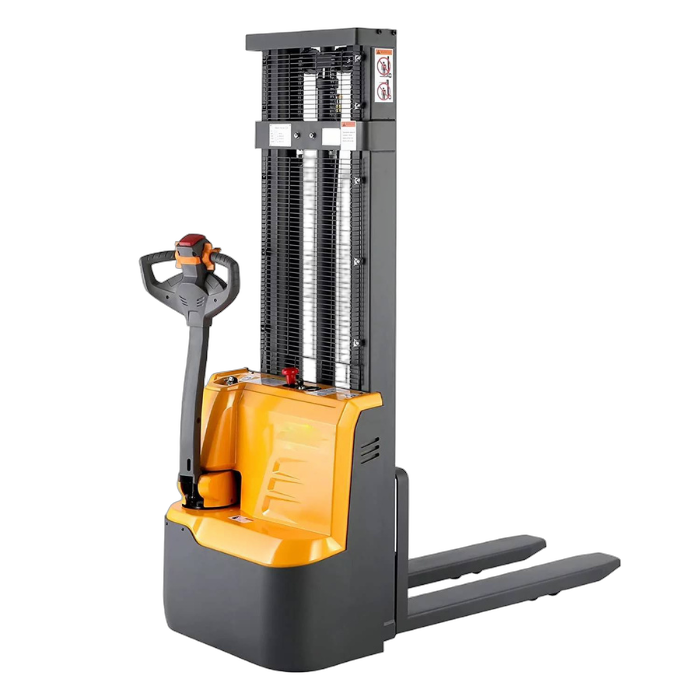

How Much Does It Cost to Run a Walkie Stacker? Energy and Maintenance Guide
Key takeaways
| Factor | Lead-Acid | Lithium-Ion |
|---|---|---|
| Annual energy cost | $300–$700 | $250–$550 |
| Annual scheduled servicing | $600–$1,500 | $500–$1,200 |
| Battery replacement cost | $1,500–$3,000 (every 4–6 years) | $3,000–$6,000 (every 8–12 years) |
| Battery replacement (amortised/year) | $250–$750 | $250–$750 |
| Wear parts (annual) | $200–$600 | $200–$600 |
| Compliance inspection | $200–$500 | $200–$500 |
| Total annual running cost | $1,550–$4,050 | $1,400–$3,600 |
| 10-year total running cost | $15,500–$40,500 | $14,000–$36,000 |
Pricing reflects 2026 Australian market conditions.
→ Comparing models before committing to a spec? Browse walkie stackers on IndustrySearch to see current models and pricing from verified Australian suppliers.
How much does it cost to run a walkie stacker?
In Australia, the total annual running cost of a walkie stacker typically ranges from $1,500 to $4,500 AUD for a single-shift commercial operation. This includes electricity ($250–$700), scheduled servicing ($500–$1,500), amortised battery replacement, wear parts, and mandatory WHS compliance inspections. Over a 10-year lifespan, operating a walkie stacker will generally cost between $14,000 and $40,000, meaning the long-term maintenance and energy expenses will often equal or exceed the initial purchase price of the machine.
Why running costs matter
Walkie stackers have significantly lower running costs than IC forklifts — but operators frequently underestimate the full cost picture by focusing on electricity alone. Battery replacement, scheduled servicing and compliance inspection are the three largest cost items after energy, and all are predictable with correct planning.
For a machine purchased at $10,000–$18,000, total 10-year running cost of $15,000–$40,000 means operating expenses equal or exceed purchase price over the unit's working life.
The most expensive walkie stacker running cost is an unplanned battery replacement caused by incorrect charging — a $1,500–$3,000 cost that correct practice routinely avoids.
Energy costs
| Battery Voltage | Energy per Full Charge | Cost per Charge (AUD) | Annual Cost (250 days) |
|---|---|---|---|
| 24V lead-acid | 4–6 kWh | $1.20–$1.80 | $300–$450 |
| 48V lead-acid | 10–14 kWh | $3.00–$4.20 | $750–$1,050 |
| 24V lithium-ion | 2.5–4 kWh | $0.75–$1.20 | $188–$300 |
| 48V lithium-ion | 5–8 kWh | $1.50–$2.40 | $375–$600 |
Based on Australian commercial electricity rate of $0.28–$0.32/kWh, 2026.
Lithium-ion charges more efficiently than lead-acid — 95–99% charge efficiency versus 75–85% — meaning less energy is lost as heat. Multi-shift operations charging twice daily will double these figures. Lithium-ion opportunity charging during breaks reduces full charge cycles required, lowering both energy cost and battery wear.
Scheduled servicing costs
| Service Type | Interval | Cost (AUD) | What's Included |
|---|---|---|---|
| Minor service | 250 hours or 6 months | $300–$600 | Drive motor check, mast lubrication, hydraulic levels, safety inspection |
| Major service | 1,000 hours or 12 months | $600–$1,200 | Full mechanical inspection, mast chains, hydraulic system, brake check, battery test |
| Full overhaul | 5,000–8,000 hours | $1,500–$4,000 | Mast seals, drive motor service, hydraulic cylinders, full electrical check |
Annual servicing typically runs $600–$1,500 for single-shift operations. Two-shift operations reaching 2,000 hours per year should budget for two major services annually. High-utilisation, cold storage and rough-floor environments should budget at the upper end.
Battery costs: The largest variable
| Factor | Lead-Acid | Lithium-Ion |
|---|---|---|
| Replacement cost | $1,500–$3,000 | $3,000–$6,000 |
| Expected lifespan | 1,200–1,500 cycles (4–6 years) | 2,500–3,000+ cycles (8–12 years) |
| Amortised annual cost | $250–$750 | $250–$750 |
| Maintenance | Water every 5–10 cycles, monthly equalisation | None — sealed unit |
| Common failure cause | Opportunity charging, deep discharge, no watering | Physical damage, wrong charger voltage |
Lead-acid battery life depends on operator discipline. Partial charging without equalisation, discharge below 20% capacity and failure to water are the three most common causes of premature failure — each reducing lifespan by 20–40%.
Despite higher replacement cost, lithium-ion delivers comparable amortised annual cost to lead-acid over its full lifespan. Zero maintenance, opportunity charging and cold temperature performance make it the better total cost choice for most commercial operations beyond single-shift use.
→ Choosing between lead-acid and lithium-ion at purchase? See the full walkie stacker buying guide for spec and model guidance across both battery types.
Wear parts and consumables
| Component | Replacement Interval | Cost (AUD) |
|---|---|---|
| Drive wheel tyre | 2,000–4,000 hours | $200–$600 per wheel |
| Load wheels | 3,000–5,000 hours | $80–$200 per wheel |
| Mast chains | 3,000–5,000 hours | $300–$800 per pair |
| Hydraulic seals | 3,000–6,000 hours | $200–$600 per cylinder |
| Brake pads | 2,000–4,000 hours | $150–$400 |
| Forks | Inspect annually — replace on crack or 10% wear | $300–$800 per pair |
Rough or abrasive floors accelerate drive wheel wear by 30–50% compared to smooth sealed surfaces. Fork inspection is safety-critical — cracked or worn forks under load are a notifiable incident under Safe Work Australia regulations. Replace forks in pairs to maintain even load distribution.
Compliance costs
<td style="border: 1px solid #ccc; padding: 8p
| Item | Cost (AUD) | Frequency |
|---|---|---|
| Formal safety inspection | $200–$500 | Annually or as required |
| Pre-operational checks | Operator time only | Before every shift |
| Operator competency training | $200–$500 per operator | At induction |
| Racking inspection (AS 4084) | $300–$800 |

-160x160-state_article-rel-cat.png)




-160x160-state_article-rel-cat.png)


-205x205.jpg)
