
Key takeaways
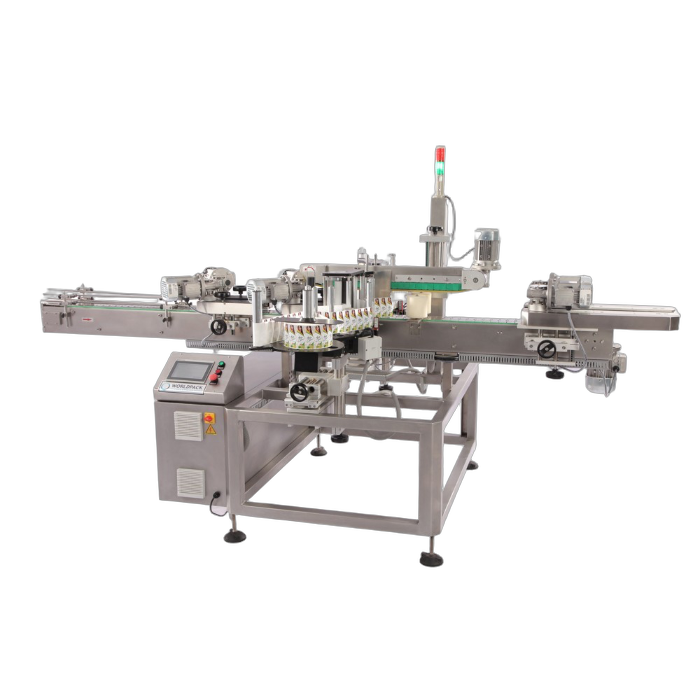
- Automatic labellers (new, 2026): $8,000-$180,000+ AUD - 20-500+ products per minute, inline integration, minimal operator input per cycle.
- Semi-automatic labellers (new, 2026): $3,000-$10,000 AUD - 5-30 products per minute, operator-fed, standalone bench or pedestal mount.
- If your line runs above 30 products per minute consistently: automatic is the correct specification - semi-automatic cannot maintain placement accuracy or operator pace at that speed.
- If your line runs under 30 products per minute: semi-automatic delivers equivalent ±1 mm placement accuracy at 30-50% lower capital cost with no integration engineering required.
- Labour cost is the decision trigger: at $35-$45/hr loaded labour cost in NSW and VIC, automatic labelling pays back in 6-18 months on lines producing 200,000+ units per year.
- Integration cost: Automatic machines require $2,000-$8,000 in integration engineering for inline installation; semi-automatic machines are standalone with zero integration cost.
- Changeover advantage: Semi-automatic changeover takes 2-5 minutes; automatic changeover takes 5-30 minutes depending on complexity - a major factor for operations running 10+ SKUs per shift.
Automatic vs semi-automatic labelling machine: Which matches your throughput? (2026)
The decision between automatic and semi-automatic labelling comes down to one number: consistent throughput. Above 30 products per minute, an automatic labeller is the only machine that maintains placement accuracy without operator fatigue degrading quality across a full shift. Below that speed, a semi-automatic machine applies the same label at the same accuracy for 30-50% less capital - and the operator remains in control of pace, which suits short-run, high-SKU-count operations.
This comparison guide puts both machine types side by side on speed, accuracy, cost, labour and the decision factors that matter at procurement stage. To compare pricing from verified Australian suppliers, see automatic labelling machines and semi-automatic labelling machines on IndustrySearch.
Operations where this comparison matters most:
- Food and beverage start-ups scaling from hand-labelling to their first machine
- Contract packers running short production runs across 10+ brand labels per week
- Manufacturers at the 150,000-300,000 unit/year threshold evaluating automation ROI
- Regional producers deciding whether current volume justifies full automation capital
Compare the core differences
Before comparing costs, confirm which machine type matches your daily throughput and SKU complexity.
Factor | Automatic | Semi-Automatic |
|---|---|---|
Speed |
20-500+ products/min |
5-30 products/min |
Operator role |
Monitor and load label rolls |
Feed each product manually, trigger label application |
Placement accuracy |
±0.5-1.5 mm consistently |
±0.5-1.5 mm per cycle (operator-dependent over long runs) |
Changeover time |
5-30 minutes |
2-5 minutes |
Installation |
Inline - requires conveyor integration |
Standalone - bench or pedestal, plug and label |
Price range (new, 2026) |
$8,000-$180,000+ |
$3,000-$10,000 |
Evaluate the key specifications
With your machine type confirmed, these are the specs that separate a good fit from an expensive mismatch.
Specification | Automatic | Semi-Automatic |
|---|---|---|
Throughput ceiling |
500+ products/min on high-speed models |
30 products/min maximum - operator pace is the bottleneck |
SKU flexibility |
Handles product variation within mechanical adjustment range |
Handles any product the operator can position - no mechanical constraints |
Label stock compatibility |
Paper, PP, PE, BOPP - must match machine spec |
Same range - but feed issues are operator-correctable in real time |
Floor space |
0.8-2.5 m inline footprint plus conveyor |
0.3-0.6 m bench footprint, no conveyor needed |
Power |
240V or 415V depending on speed |
240V single phase - standard wall outlet |
Understand the full cost breakdown (2026 prices)
Purchase price is only part of the picture - the labour cost difference is where the real decision sits. Here is the full breakdown.
Cost Category | Automatic | Semi-Automatic |
|---|---|---|
Machine purchase (new) |
$8,000-$180,000+ |
$3,000-$10,000 |
Integration engineering |
$2,000-$8,000 |
$0 (standalone) |
Annual maintenance |
$1,500-$5,000 |
$300-$800 |
Operator labour (per shift) |
Monitoring only - 10-15% of one FTE |
Dedicated operator - 100% of one FTE per machine |
Annual label waste |
$500-$3,000 (calibration-dependent) |
$200-$800 (lower volume, operator-corrected) |
At $35-$45/hr loaded labour cost in NSW and VIC, dedicating one operator to semi-automatic labelling costs $70,000-$90,000 per year per shift. An automatic labeller running the same volume needs 10-15% of an operator's time, freeing $60,000-$80,000 in annual labour capacity. For a mid-range automatic system at $20,000-$60,000, that labour saving delivers payback in 6-18 months on lines producing 200,000+ units per year. Get quotes for automatic labelling machines to compare pricing across verified Australian suppliers.
Decision framework - automatic vs semi-automatic
Decision Factor | Choose Automatic | Choose Semi-Automatic |
|---|---|---|
Consistent throughput |
30+ products/min across full shifts |
Under 30 products/min or intermittent runs |
Annual volume |
200,000+ labelled units/year |
Under 200,000 units/year |
SKU changes per shift |
Under 5 (changeover time is 5-30 min) |
10+ (changeover is 2-5 min, suits high-mix low-volume) |
Capital budget |
$20,000+ available for machine + integration |
Under $10,000 total budget |
Floor space |
0.8-2.5 m inline space available |
Bench space only - no inline conveyor available |
Growth trajectory |
Volume expected to grow 30%+ in 12-24 months |
Volume stable or contract-dependent |
Evaluate suppliers
You are ready to go to market. Use this checklist to assess each supplier against the same criteria.
Factor | What to Ask |
|---|---|
Speed at your product |
What is the rated speed at my product dimensions and label size? |
Accuracy guarantee |
Do you guarantee placement accuracy under continuous production? |
Changeover |
How long is a full SKU changeover and is it tool-free? |
Integration |
Do you provide integration engineering and PLC programming for inline installation? |
Parts in Australia |
Are label heads, sensors and belts stocked locally? |
Service contract |
Do you offer a fixed-price annual service agreement? |
Sample trial |
Can I run my products and labels through the machine before committing? |
Warranty |
What is the warranty period and does it cover consumable components? |
Emergency response |
What is your callout response time in my state? |
Upgrade path |
Can I start semi-automatic and upgrade to automatic on the same platform later? |
Frequently asked questions
At what production volume should i switch from semi-automatic to automatic labelling?
The crossover point is typically 200,000 labelled units per year at $35-$45/hr loaded labour cost. Above that volume, labour savings on automatic labelling deliver payback within 6-18 months.
Can a semi-automatic labeller achieve the same placement accuracy AS automatic?
Per-cycle accuracy is comparable at ±0.5-1.5 mm on both machine types. The difference is consistency over a full shift - operator fatigue on semi-automatic degrades placement quality after 4-6 hours of continuous feeding.
Is it worth buying automatic if i only run 3-4 hours of labelling per day?
It depends on throughput during those hours. If you are labelling 40+ products per minute for 3-4 hours, automatic still delivers enough labour saving to justify the capital. If throughput is under 30/min, semi-automatic is the better fit.
What is the typical maintenance difference between automatic and semi-automatic labellers?
Automatic machines cost $1,500-$5,000 per year in maintenance covering sensors, belts and label head calibration. Semi-automatic machines cost $300-$800 per year - fewer moving parts and lower mechanical complexity reduce the maintenance burden.
Can i upgrade from semi-automatic to automatic later without replacing the entire machine?
Some manufacturers offer modular platforms where the semi-automatic unit can be upgraded with a conveyor module and automatic feed system. Ask suppliers specifically whether their platform supports this upgrade path before purchasing.
What matters most
- The decision between automatic and semi-automatic labelling is driven by consistent throughput - 30 products per minute is the crossover point
- Semi-automatic delivers equivalent per-cycle accuracy at 30-50% lower capital cost for operations under 200,000 units per year
- Labour cost is the primary ROI driver - at $35-$45/hr loaded cost, automatic pays back in 6-18 months on high-volume lines
- Changeover time favours semi-automatic for high-SKU-count short-run operations
- Integration engineering adds $2,000-$8,000 to automatic installations - include this in your cost model
- Both machine types are available from verified Australian suppliers on IndustrySearch - automatic and semi-automatic
Most buyers shortlist 2-3 machines after requesting quotes from both categories.
Do not waste time contacting suppliers individually. IndustrySearch gives you direct access to verified Australian labelling machine suppliers - where industrial buyers request and compare multiple quotes so they can buy with confidence.
- Get quotes for labelling machines - contact multiple verified suppliers with a single enquiry
- Compare models - filter by speed, configuration and region
- Contact suppliers directly - speak to specialists who service your state
→ Get and compare labelling machine quotes now →


-160x160-state_article-rel-cat.png)