
Key takeaways
- Entry-level automatic labellers (new, 2026): $8,000-$20,000 AUD for single-sided flat surface machines running up to 40 products per minute.
- Mid-range automatic labellers (new): $20,000-$60,000 AUD for wrap-around and two-sided systems at 60-150 products per minute.
- High-speed automatic labellers (new): $60,000-$180,000+ AUD for multi-head, high-precision systems running 150-500+ products per minute.
- Annual running costs: $2,000-$8,000 covering label stock waste, print heads, sensors and servicing - label waste alone accounts for 40-60% of ongoing cost on poorly calibrated machines.
- If your line runs under 30 products per minute consistently: a semi-automatic labeller at $3,000-$10,000 delivers the same accuracy at lower capital cost.
- Payback period: Most operations recoup the investment in 6-18 months through reduced label waste, lower rework rates and labour reallocation from manual application.
- ATO depreciation: 10-year effective life, 20% diminishing value rate - machines under $20,000 may qualify for the instant asset write-off.
Automatic labelling machine prices in Australia: What production lines should budget in 2026
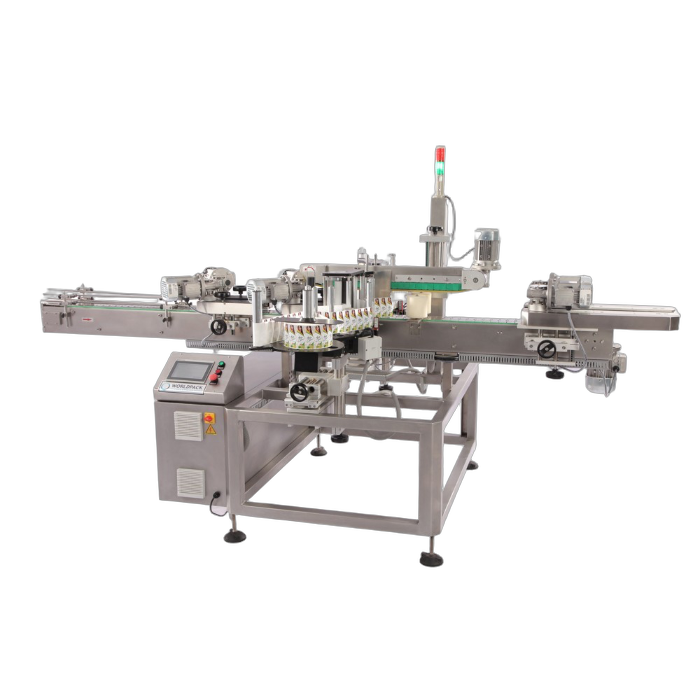
An automatic labelling machine applies pressure-sensitive or sleeve labels to products at consistent speed and placement accuracy that manual or semi-automatic application cannot match above 30 units per minute. Australian food, beverage and pharmaceutical manufacturers are investing in automatic labelling at an increasing rate as retailer labelling compliance requirements tighten and labour costs push per-unit hand-application above the break-even point for automation.
This guide breaks down purchase price, running costs, TCO, depreciation and financing for automatic labelling machines in Australia so production managers and procurement leads can build a complete cost model before going to approval. To compare pricing from verified Australian suppliers, get quotes for automatic labelling machines on IndustrySearch.
Operations where automatic labelling is the standard specification:
- Food and beverage manufacturers running 40+ SKUs with retailer-mandated label placement tolerances
- Pharmaceutical and nutraceutical production lines requiring GMP-compliant label traceability
- Cosmetics and personal care manufacturers with front-and-back label application
- Chemical and industrial product lines with hazardous goods labelling obligations under GHS
- Contract packers and co-manufacturers running multiple brand labels across shared lines
Choose your labelling configuration
Before costing anything, confirm which configuration suits your production line. Your choice here sets your price bracket and most of the specs that follow.
Type | Key Spec | Best For |
|---|---|---|
Top/flat surface |
20-80 products/min, single label head |
Trays, cartons, pouches with one flat label surface |
Wrap-around |
40-200 products/min, rotary or linear |
Bottles, jars, cylinders requiring full or partial wrap |
Front-and-back (two-sided) |
40-150 products/min, dual label heads |
Bottles, tubs and containers needing front branding + back compliance panel |
Multi-head / high-speed |
150-500+ products/min, servo-driven |
High-volume FMCG, pharmaceutical and beverage lines |
If your line runs round containers at 40+ per minute, wrap-around is the default. If you need front and back labels on the same pass, a two-sided system eliminates the need for a second labeller downstream.
Wrap-around suits you if your products are cylindrical or tapered and need a single continuous label. Most Australian beverage and sauce manufacturers standardise on wrap-around because it handles bottle diameter variation within a single machine setup.
Front-and-back suits you if retailer compliance requires a separate back panel with ingredients, barcodes and regulatory text. Running two labels in one pass eliminates a second machine and halves changeover time compared to separate front and back labelling stations.
Evaluate the key specifications
With your labelling configuration confirmed, these are the specs that determine whether a given model fits your production line.
Specification | Typical Range | Buyer Consideration |
|---|---|---|
Labelling speed |
20-500+ products/min |
Size to your peak throughput, not average - a machine running at 90%+ capacity continuously wears faster and jams more often |
Label placement accuracy |
±0.5 mm to ±1.5 mm |
Retailer-mandated placement tolerances in Australian grocery are typically ±1 mm - confirm before specifying |
Product diameter range |
20-200 mm |
Wrap-around machines need mechanical adjustment or servo-driven auto-adjustment for diameter changes between SKUs |
Label roll diameter |
200-400 mm OD |
Larger rolls reduce changeover frequency - a 400 mm roll lasts 2-3 times longer than 200 mm before replacement |
Integration |
Standalone or inline |
Inline integration requires conveyor height matching, encoder sync and PLC communication with your existing line |
Changeover time |
5-30 minutes |
Operations running 5+ SKU changes per shift should specify tool-free changeover to keep downtime under 10 minutes |
Understand the full cost breakdown (2026 prices)
Purchase price is only part of the picture - most cost models that get rejected at approval stage have missed the running cost layer. Here is the full breakdown.
Category | Price Range (AUD) | Typical Configuration |
|---|---|---|
Entry-level new (top/flat, single head) |
$8,000-$20,000 |
20-40 products/min, manual roll changeover, standalone |
Mid-range new (wrap-around or front-and-back) |
$20,000-$60,000 |
60-150 products/min, servo-driven, inline integration |
High-spec new (multi-head, high-speed) |
$60,000-$180,000+ |
150-500+ products/min, vision verification, PLC-integrated |
Used/refurbished |
$4,000-$40,000 |
Condition-dependent - check label head wear, sensor calibration and belt tracking |
Annual maintenance |
$1,500-$5,000/year |
Sensor cleaning, belt tensioning, label head calibration, pneumatic seal replacement |
Label stock waste |
$500-$3,000/year |
Poorly calibrated machines waste 3-8% of label stock - calibration pays for itself within one quarter |
Five-year TCO on a mid-range wrap-around system sits at $28,000-$80,000 including purchase, installation, maintenance, consumables and label waste. The most common mistake is underestimating label waste cost - a machine running 1% above optimal waste rate on a line producing 500,000 units per year adds $1,500-$4,000 in unnecessary label cost annually. For a mid-range system at $20,000-$60,000, get quotes for automatic labelling machines to compare pricing from verified Australian suppliers.
Operations producing more than 200,000 labelled units per year typically reach payback within 6-12 months when replacing manual application. Below that threshold, a semi-automatic labelling machine may deliver the same accuracy at 30-50% lower capital outlay.
Plan the asset (depreciation and financing)
The ATO effective life for labelling and packaging machinery is 10 years. Under diminishing value, the depreciation rate is 20%; prime cost is 10% per annum. The instant asset write-off threshold for 2025-26 is $20,000 - entry-level single-head systems fall within this.
Residual value at 8-10 years for well-maintained servo-driven labellers is 10-20% of purchase price. Operations with seasonal or contract-dependent volume should consider operating lease arrangements at $400-$1,200/month for mid-range systems, which convert capital expenditure to a fixed monthly line item and preserve cash flow for label stock and consumable spend.
Evaluate suppliers
You are ready to go to market. Use this checklist to assess each supplier against the same criteria.
Factor | What to Ask |
|---|---|
Speed vs your throughput |
What is the rated speed at my typical product size and label dimensions? |
Placement accuracy |
What placement tolerance does this machine achieve under continuous production? |
Changeover time |
How long does a full SKU changeover take and is it tool-free? |
Line integration |
Can this machine integrate with my existing conveyor and PLC? What communication protocol does it use? |
Spare parts |
Are label heads, sensors and belts stocked in Australia or imported to order? |
Annual service cost |
What does a standard annual service include and what is the fixed price? |
Label compatibility |
What label stock types, adhesive grades and roll dimensions does this machine accept? |
Vision verification |
Does this model include or support add-on vision inspection for label presence and position? |
Warranty coverage |
What is the warranty period and does it cover label head and sensor replacement? |
Trial or demo |
Can you run sample labels on my actual product before I commit? |
Emergency callout |
What is your callout fee and typical response time in my state? |
Frequently asked questions
What should an Australian manufacturer budget for an automatic labelling machine in 2026?
Entry-level single-head flat surface labellers start at $8,000-$20,000, mid-range wrap-around and two-sided systems run $20,000-$60,000, and high-speed multi-head lines cost $60,000-$180,000+. Add $1,500-$5,000 per year for maintenance and $500-$3,000 for label waste.
At what production volume does automatic labelling justify the capital over semi-automatic?
Most operations reach break-even at 200,000+ labelled units per year when comparing labour cost of manual application against machine throughput. Below that volume, a semi-automatic system at $3,000-$10,000 delivers the same placement accuracy at lower capital cost.
How long should an automatic labelling machine last before replacement?
Well-maintained servo-driven labellers typically run 10-15 years before major component replacement is required. Label head assemblies and sensors are the most common wear items, replaced every 3-5 years depending on label stock abrasiveness and production hours.
What ongoing costs do most buyers underestimate when budgeting for a labeller?
Label stock waste is the most commonly missed line item - machines running above optimal waste rate add $1,500-$4,000 in unnecessary cost per year on a 500,000-unit line. Quarterly sensor calibration and annual belt replacement are the other two items buyers often exclude from their cost model.
What compliance requirements apply to labelling machinery in Australian manufacturing?
Machines must comply with AS 4024 safety standards for industrial machinery, including guarding and emergency stop requirements. Food-contact labelling lines in NSW and VIC must also meet FSANZ-aligned hygiene design requirements where labels are applied to exposed food surfaces.
What matters most
- Automatic labelling machines cost $8,000-$180,000+ in Australia depending on speed, head count and integration complexity
- Five-year TCO on a mid-range system runs $28,000-$80,000 including purchase, consumables and maintenance
- Label waste is the most underestimated ongoing cost - calibration and sensor maintenance pay for themselves within one quarter
- Operations below 200,000 units per year should evaluate semi-automatic machines before committing to full automation
- Changeover time is a critical spec for multi-SKU lines - tool-free changeover keeps downtime under 10 minutes per switch
- If you are within 3 months of purchasing, get quotes now to lock in current pricing and lead times before Q3 supply tightens
Most buyers shortlist 2-4 models after comparing quotes side by side.
Do not waste time contacting suppliers individually. IndustrySearch gives you direct access to verified Australian automatic labelling machine suppliers - where industrial buyers request and compare multiple quotes so they can buy with confidence.
- Get quotes for automatic labelling machines - contact multiple verified suppliers with a single enquiry
- Compare models - filter by speed, configuration and region
- Contact suppliers directly - speak to specialists who service your state
→ Get and compare automatic labelling machine quotes now →


-160x160-state_article-rel-cat.png)