
Key takeaways
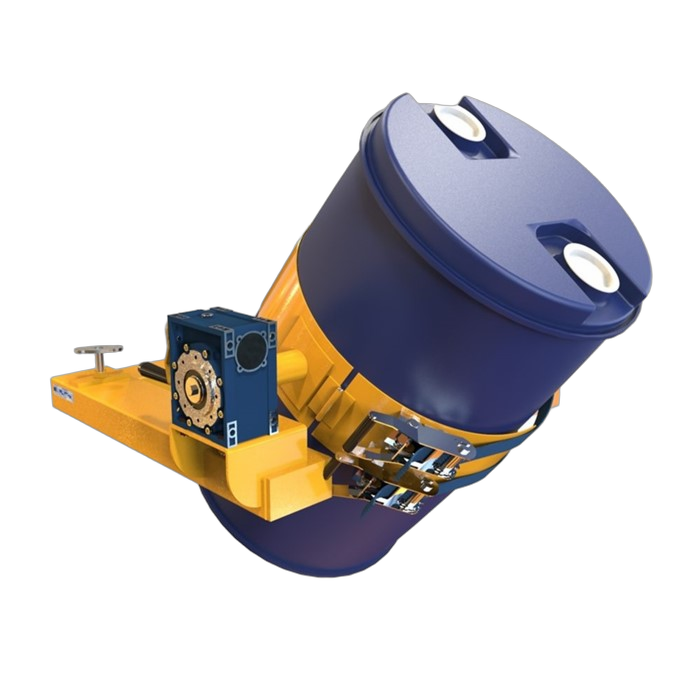
- Configuration first: Manual/gravity, hydraulic or fully powered - this choice determines your pour control precision, forklift hydraulic circuit requirements and price bracket.
- Capacity check: Match the rated capacity to your heaviest loaded drum including tare weight - and confirm your forklift's derated capacity with the attachment fitted.
- If your drums are poly or fibre: standard steel drum clamps will not grip them safely - specify a model with adjustable clamp profiles or dedicated poly drum jaws.
- WHS driver: Manual handling of loaded 205L drums (200+ kg) is a documented high-risk activity under WHS Regulations 2017 - a forklift-mounted rotator is a recognised engineering control.
- Stainless steel construction: Required for food-grade, pharmaceutical or corrosive chemical environments - adds 30-60% to the mild steel price.
- Forklift compatibility: Confirm carriage class (II or III), fork pocket dimensions and whether your forklift has a spare hydraulic circuit for powered models.
- Price range (2026): $1,800-$14,000+ depending on power source and capacity. For full pricing tiers, TCO and payback modelling, see the price guide.
The operations manager's guide to buying a forklift drum rotator and tipper (2026)
A forklift drum rotator and tipper replaces the most physically demanding material handling task on most warehouse and production floors - the controlled tipping of 200+ kg loaded drums. In NSW and VIC, workers compensation claims for manual drum handling injuries cost employers $8,000-$25,000 per incident in direct costs alone, before accounting for lost production time.
This guide covers configuration selection, key specifications, compliance requirements and supplier evaluation for forklift drum rotators and tippers in Australia. For full pricing tiers, running costs, five-year TCO and depreciation, see the drum rotator price guide. To compare pricing from verified suppliers, get quotes for drum rotators on IndustrySearch.
Operations where drum rotators are the standard specification:
- Chemical blending and manufacturing facilities handling bulk raw materials in 205L drums
- Food and beverage production receiving oils, syrups and concentrates in drum format
- Pharmaceutical and cosmetic manufacturers with drum-to-vessel transfer
- Waste and recycling operations tipping drums into hoppers, tanks or processing equipment
Choose your configuration
Before evaluating suppliers, confirm which configuration matches your drum handling requirements. Your choice here sets your pour control capability and forklift compatibility requirements.
Type | Key Spec | Best For |
|---|---|---|
Manual/gravity-assist |
Chain or gear-driven, up to 350 kg |
Low-volume, non-hazardous drum tipping (5-15 drums/shift) |
Hydraulic forklift-mounted |
Forklift hydraulic powered, 500-700 kg |
Controlled pour speed, chemical and food-grade operations |
Fully powered 360-degree |
Variable speed motor, 700-1,000 kg |
High-volume, hazardous materials, precision batch pouring |
If your drums contain non-hazardous dry goods and tipping volume is under 15 per shift, manual is the correct specification. If you handle chemicals or need repeatable pour angles, hydraulic or powered is required.
Manual suits you if drum contents are non-hazardous and your forklift does not have a spare hydraulic circuit. These mount directly to standard fork pockets with no hydraulic connections.
Hydraulic or powered suits you if controlled pour speed is a process requirement or your operation handles hazardous chemicals. The most common mistake is fitting a manual rotator for chemical drum emptying and relying on operator skill for pour rate - this fails both the WHS risk assessment and batch consistency requirements.
Evaluate the key specifications
With your configuration confirmed, these are the specs that determine safe and efficient operation.
Specification | Typical Range | Buyer Consideration |
|---|---|---|
Rated capacity |
350-1,000 kg |
Must exceed your heaviest loaded drum weight including tare |
Drum compatibility |
Steel, poly, fibre, open/closed top |
Poly drums require adjustable clamp jaws - standard steel clamps will slip |
Rotation range |
180-360 degrees |
360-degree needed for complete emptying; 180-degree suits pour-and-return |
Attachment weight |
80-250 kg |
Combined with drum weight, must stay within forklift derated capacity |
Carriage mounting |
Class II or III |
Confirm your forklift carriage class matches the attachment |
Construction |
Mild steel or stainless |
Stainless adds 30-60% cost but is mandatory for food, pharma and corrosive environments |
Confirm your budget range
Drum rotators cost $1,800-$14,000+ in Australia depending on power source and capacity. For the full pricing table, running cost breakdown, five-year TCO and depreciation, see the price guide. For a mid-range hydraulic model at $3,500-$7,000, get quotes for drum rotators to compare pricing from verified Australian suppliers.
Plan the asset
The ATO effective life for forklift attachments is 10 years and all configurations qualify for the $20,000 instant asset write-off. For full depreciation rates and finance framing, see the price guide.
Australian compliance requirements
Drum rotator and tipper attachments in Australian workplaces must meet these requirements:
- WHS Regulations 2017: manual handling of loads above 20 kg requires risk assessment and engineering controls - a forklift-mounted rotator eliminates the manual handling hazard
- AS 2359 powered industrial trucks series applies to forklift attachment selection, load capacity derating and operator training requirements
- Dangerous goods handling: operations tipping drums containing DG Class materials must comply with state-specific DG storage and handling codes
- Food-grade environments: stainless construction and food-safe design required where drum contents contact the attachment
- Forklift operators must hold a current LF class High Risk Work Licence and receive specific training on the attachment per AS 2359
- Load testing: new and refurbished attachments should be supplied with a current load test certificate
Evaluate suppliers
You are ready to go to market. Use this checklist to assess each supplier against the same criteria.
Factor | What to Ask |
|---|---|
Forklift fit |
Does this attachment fit my specific forklift make, model and carriage class? |
Derated capacity |
What is my forklift's revised capacity with this attachment at the combined load centre? |
Drum types |
Does this handle steel, poly and fibre drums, or do I need separate clamp jaws? |
Rotation control |
Can rotation be stopped precisely at any angle for controlled pouring? |
Stainless option |
Is a stainless steel version available and what is the price premium? |
Spare parts |
Are hydraulic seals, clamp pads and bearings stocked in Australia? |
Load test cert |
Do you provide a current load test certificate on delivery? |
Warranty |
What is the warranty period and what does it cover? |
ATEX rating |
Is an ATEX-rated version available for explosive atmosphere zones? |
Hire/trial |
Can I hire this attachment for a trial period before purchase? |
Frequently asked questions
Can a single drum rotator handle both steel and poly drums?
Some models accept interchangeable clamp jaws for different drum materials. Standard steel drum clamps will slip on smooth poly drums - confirm the supplier offers a poly-compatible option or adjustable jaw system.
Do operators need additional training to use a drum rotator attachment?
Operators must hold a current LF class HRWL and receive specific training on the attachment per AS 2359. Most suppliers include basic attachment training at delivery.
What is the difference between 180-degree and 360-degree rotation?
180-degree handles pour-and-return for partial emptying or controlled dispensing. 360-degree is required for complete drum emptying where residual contents must be fully discharged.
When should i choose a drum rotator over a drum lifter and clamp?
If your process requires controlled tipping, pouring or emptying, a rotator is the correct specification. If you only lift, transport and stack drums without tipping, a lifter and clamp at $1,200-$4,000 handles the job at lower cost.
What WHS obligations apply to drum handling in Australian workplaces?
Under WHS Regulations 2017, manual handling of loads above 20 kg requires documented risk assessment and control measures. A forklift-mounted drum rotator is a recognised engineering control that eliminates the hazard at source.
What matters most
- Configuration choice (manual, hydraulic, powered) determines pour control, forklift compatibility and price bracket
- Forklift capacity derating is the most commonly overlooked factor - confirm revised capacity before operating
- Poly and fibre drums require purpose-built clamp jaws - standard steel clamps will not grip safely
- Manual drum handling above 20 kg triggers WHS risk assessment obligations
- Stainless construction adds 30-60% to price but is mandatory in food, pharma and corrosive environments
- If you are within 3 months of purchasing, request quotes now to confirm forklift compatibility and compare specifications
Most buyers shortlist 2-3 models after confirming their forklift's derated capacity and drum type compatibility.
Do not waste time contacting suppliers individually. IndustrySearch gives you direct access to verified Australian forklift drum rotator and tipper suppliers - where industrial buyers request and compare multiple quotes so they can buy with confidence.
- Get quotes for forklift drum rotators and tippers - contact multiple verified suppliers with a single enquiry
- Compare models - filter by capacity, configuration and region
- Contact suppliers directly - speak to specialists who service your state
→ Get and compare forklift drum rotator quotes now →

-160x160-state_article-rel-cat.png)




-160x160-state_article-rel-cat.png)