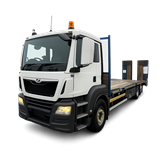
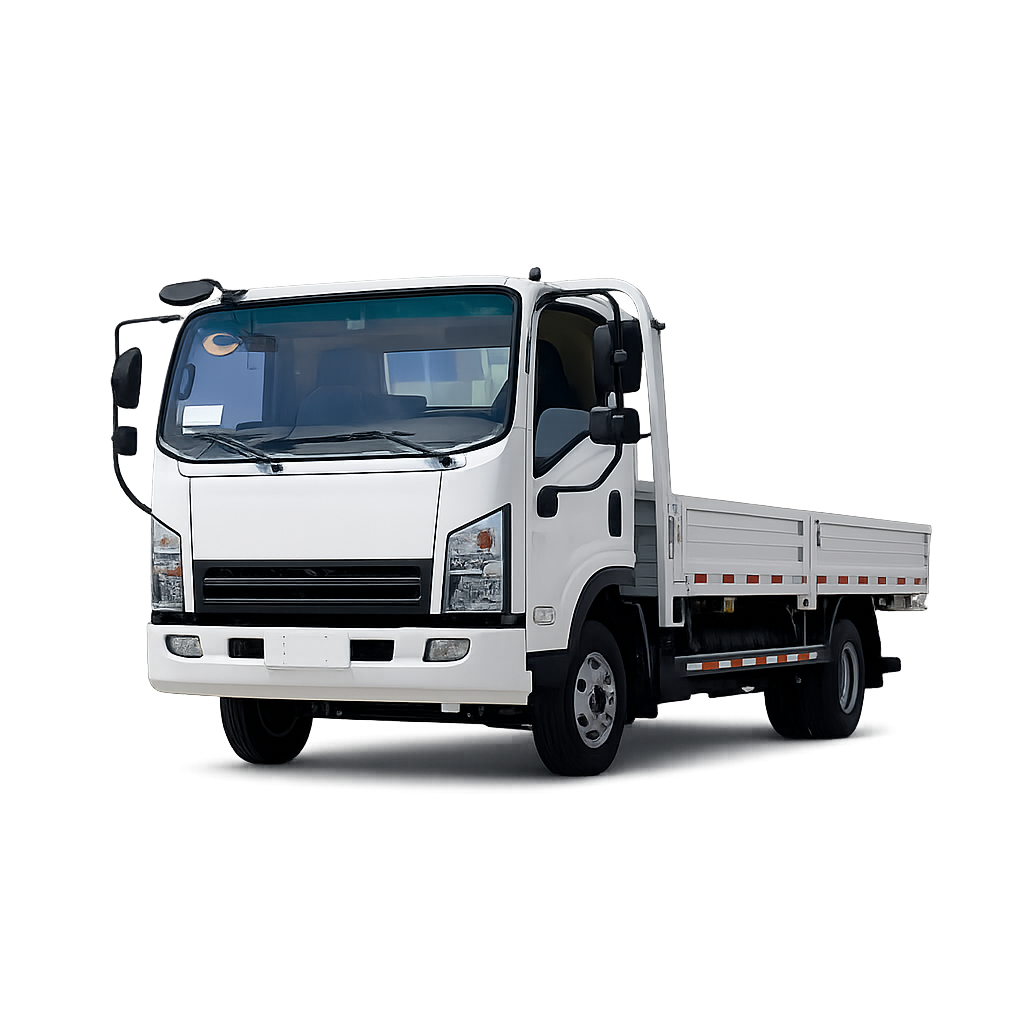

Key takeaways
Licence follows GVM: a car (C) licence covers trucks up to 4.5t GVM. From 4.5t to 8t you need Light Rigid (LR); above 8t on two axles, Medium Rigid (MR).
Car-licence payload is smaller than most buyers expect: a 4.5t tray truck typically carries about 1.6t to 2t once the truck, tray and driver are counted.
Dual-rated trucks give you a choice: the same Hino 616 with a 4.5m alloy tray carries 1,650kg on a car licence or 2,650kg registered for LR. Set the rating at first registration; changing it later needs engineering certification.
Tray material costs payload: one tray builder's aluminium tray weighed about a third of the equivalent steel tray, freeing almost 575kg. Steel handles concentrated point loads better.
A tray's floor rating isn't your payload: a deck "rated to 5 tonnes" on a 4.5t truck can still only legally carry what GVM allows. Get the finished truck weighed.
Which licence do you need to drive a tray truck?
The licence class depends on the truck's gross vehicle mass (GVM), not its length or engine size. These classes are national, with minor state differences in how you qualify.
Licence | What it covers | Typical tray trucks |
|---|---|---|
C (car) | Vehicles up to 4.5t GVM | Fuso Canter 515, Hino 616, Isuzu NLR/NNR at 4,495 to 4,500kg |
LR (Light Rigid) | Rigid vehicles over 4.5t and up to 8t GVM | Isuzu NPR, Hino 716/816, Canter 615 rated as a light truck |
MR (Medium Rigid) | Two-axle rigid vehicles over 8t GVM | Isuzu NQR 8.8t, Isuzu FRR 11t |
HR (Heavy Rigid) | Rigid vehicles with three or more axles over 8t GVM | Six-wheeler tray trucks |
Upgrading is usually straightforward. Most states require you to have held a full car licence for at least a year before getting an LR licence. In WA, for example, passing the test in an automatic restricts you to automatic trucks.
One rule that surprises new owners works in your favour. National fatigue laws, including work diaries, apply to trucks over 12t GVM. Light and most medium tray trucks sit under that line.
How much can a car-licence tray truck carry?
Payload is GVM minus the truck's tare weight. On a 4.5t truck, that leaves roughly 1.6t to 2t, depending on the cab, tray and accessories.
Two current examples:
A Hino 300 616 with a 4.5m x 2.1m alloy tray is quoted at 1,650kg payload on a car licence.
A Fuso Canter 515 city cab with a 3.5m alloy tray is advertised with a 2t payload.
Everything you add comes out of that figure: the driver and passengers, fuel, toolboxes, ladder racks, a crane or a water tank. A 100kg toolbox and two workers can take 250kg off before you load anything.
Floor space and payload also run out at different points. A 4.5m x 2.4m tray fits six standard 1,165mm Australian pallets, but on a 1,650kg payload each pallet would need to average under 275kg. If your loads are dense, such as pavers, steel or bagged cement, you will hit the weight limit long before the tray is full.
What is a dual-rated tray truck?
A dual-rated truck is built to carry a higher GVM but can be registered at 4.5t so car-licence holders can drive it. You choose the rating when it is first registered.
Truck | Car-licence rating | Light rigid rating |
|---|---|---|
Hino 300 616, 4.5m alloy tray | 1,650kg payload | 2,650kg payload |
Isuzu NPR 70/45-190 Tradepack | 4,500kg GVM, 9,000kg GCM | 7,000kg GVM, 10,500kg GCM |
Fuso Canter 615 Tipper | 4.5t GVM | About 1,500kg extra payload as a light truck |
The higher rating adds payload, but every driver then needs an LR licence. Before choosing, count who in your business will actually drive the truck, including casuals and future hires.
You can change the rating later, but it is not a paperwork exercise. A used truck usually needs an independent engineer to certify the re-rating, often supported by a letter from the manufacturer. Buying a new truck at the right rating avoids that step.
Steel or aluminium tray: which should you choose?
Choose aluminium if payload matters most, and steel if you carry concentrated or rough loads such as bollards, concrete or scrap.
Factor | Aluminium tray | Steel tray |
|---|---|---|
Weight | About a third of an equivalent steel tray, per one tray builder | Heavier; reduces payload |
Point loads | Can bend if heavy loads sit in one spot | Resists concentrated loads |
Corrosion | Does not rust | Needs paint or galvanising maintenance |
Build time | Can be fabricated quickly | Can take several weeks |
Cost | Quotes vary by builder | Quotes vary by builder |
One tray builder told Hino about a customer whose aluminium tray bent because he always loaded concrete bollards in the centre. The tray was rated for the weight, but the load was not spread. If your loads are heavy and concentrated, a steel deck or a reinforced aluminium floor is worth the payload trade-off.
How to choose the right tray truck size
Work from your heaviest regular job, not your average one.
Weigh your heaviest regular load, plus tools, toolboxes and crew.
Measure the longest item you carry. Common factory trays are about 3.5m, 4.2m and 4.5m long; the Isuzu NPR Tradepack comes in 3.6m or 4.5m internal lengths.
Check who will drive it and what licence they hold.
Add towing needs. Check the truck's braked towing capacity and GCM. The Hino 616 is rated to tow 3,500kg braked.
Leave a margin. A truck loaded to its limit every day is one extra toolbox away from being overweight.
Ask for the weighbridge tare of the finished truck, so you know its real payload before you sign.
If your loads regularly exceed about 2t on a car licence or 4t on an LR truck, or you carry material longer than a 4.5m tray, look at medium-duty trucks. An 11t Isuzu FRR, for example, can be fitted with a 6.5m steel tray, but it needs an MR licence.
Once you know the GVM, tray size and licence you need, you can request quotes from tray truck suppliers on IndustrySearch on that exact spec.
Frequently asked questions
What do GVM and GCM mean?
GVM is the maximum legal weight of the truck and its load. GCM is the maximum combined weight of the truck, its load and anything it tows.
Can I tow a trailer with a car-licence truck?
Yes, within the truck's towing capacity and GCM. A car licence also allows a single trailer up to 9t GVM, but the truck's own ratings will limit you first.
Can I increase the GVM on the truck I already own?
Only if the truck is designed for it. A re-rating usually needs an engineer's certification and often a manufacturer's letter confirming the chassis is identical to the heavier variant.
Do I need a work diary for a light tray truck?
Not under national fatigue laws, which apply to vehicles over 12t GVM. WA has its own fatigue rules, so check if you operate there.
-160x160-state_article-rel-cat.png)
-160x160-state_article-rel-cat.png)



-160x160-state_article-rel-cat.png)