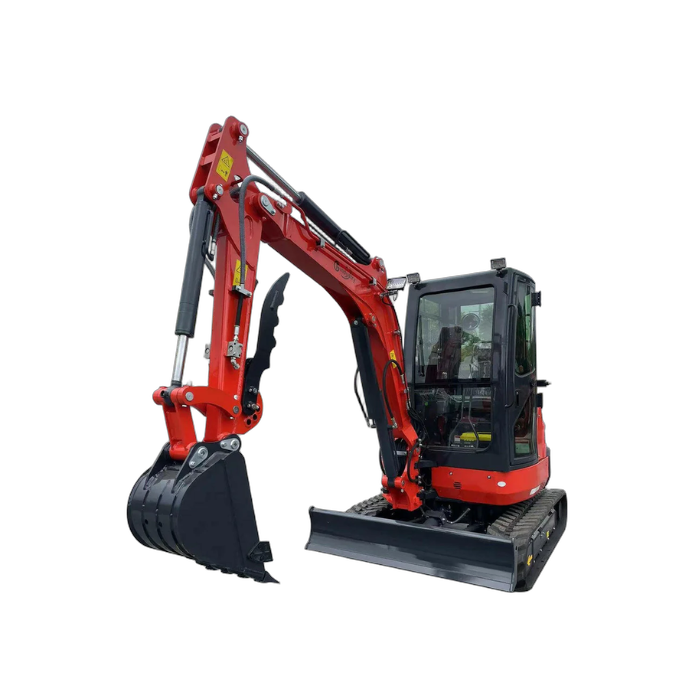

Key takeaways
| Factor | Skid Steer | Mini Excavator |
|---|---|---|
| Primary strength | Versatile material handling, loading, grading | Precision digging, trenching, confined excavation |
| Typical price range (new) | $35,000–$90,000 AUD | $40,000–$120,000 AUD |
| Operating weight | 1,500–4,500 kg | 1,000–8,000 kg |
| Attachment versatility | High — buckets, augers, breakers, mulchers, forks | Moderate — buckets, breakers, augers, thumbs, tilt rotators |
| Access width (compact models) | 900mm–1,200mm | 750mm–1,100mm |
| Fuel consumption | 4–10 L/hour | 3–8 L/hour |
| Operator licence required | No — competency training required | No — competency training required |
| Best single-machine choice | Mixed sites needing material movement and versatility | Sites requiring precise digging, trenching or confined access |
Why this decision matters
Skid steers and mini excavators are the two most commonly compared compact machines in Australian landscaping and construction. They overlap in some applications but are fundamentally different tools — and the wrong choice increases hired supplementary equipment costs, reduces site productivity and limits the work types you can bid for.
Neither machine is universally superior. The right choice depends on your primary task mix, site conditions and whether attachment versatility or digging precision drives more of your revenue.
If your work is primarily moving, loading and grading material — skid steer loader. If your work is primarily digging, trenching and precise excavation — mini excavator. If you do both regularly, read on.
What each machine does best
| Task | Skid Steer | Mini Excavator |
|---|---|---|
| Bulk material loading | ? Strong | ? Poor |
| Grading and levelling | ? Strong | ? Limited |
| Trenching | ? With attachment | ? Strong |
| Precision digging | ? Limited | ? Strong |
| Confined space excavation | ? Limited | ? Strong (zero-swing models) |
| Pallet and material handling | ? Strong | ? Not applicable |
| Vegetation clearing / mulching | ? Strong (with mulcher) | ? Not applicable |
| Demolition (light) | ? With breaker | ? With breaker |
| Post holes / auger work | ? With auger | ? With auger |
| Slope and bank work | ? Moderate | ? Strong |
| Utility / service trenching | ? With trencher attachment | ? Strong |
| Working adjacent to structures | ? Limited | ? Strong (reduced-swing) |
? Quick check: Count the ticked tasks in your typical working week. If loading, grading, clearing and pallet handling dominate — skid steer. If trenching, precision digging and working near structures dominate — mini excavator. If the split is close to even, read the cost and access sections before deciding.
Head-to-head comparison
| Factor | Skid Steer | Mini Excavator |
|---|---|---|
| Digging depth | Limited — bucket at ground level only | 1.5–4.5 m depending on model |
| Digging precision | Low — push and scoop action | High — independent boom, arm and bucket control |
| Material handling | High — bucket, forks, 4-in-1 options | Low — not designed for loading tasks |
| Site mobility | High — fast, tight turning radius | Moderate — slower travel, tracks limit speed |
| Ground disturbance | Moderate — tyres can churn soft ground | Low — tracks spread load, minimal surface damage |
| Attachment range | Very broad | Moderate — digging-focused |
| Operator visibility | Good forward | Good 360° (cab rotation) |
| Stability on slopes | Moderate | High — low centre of gravity |
| Setup time per task | Fast — drive and work | Moderate — position, stabilise, work |
? If the mini excavator is ticking more boxes for your task mix but you're worried about access width, zero-swing models close the gap — compare both before ruling either out.
Site access and footprint
Both machines are available in compact configurations for tight access, but they differ in how they navigate confined spaces.
| Factor | Skid Steer | Mini Excavator |
|---|---|---|
| Minimum access width (compact) | 900mm–1,200mm | 750mm–1,100mm |
| Turning mechanism | Skid steer — zero turn radius | Tracks — pivot turn |
| Working near structures | Requires clearance to swing and operate | Zero-swing tail models work flush against walls |
| Ground surface suitability | Hard surfaces, gravel, compacted ground | Soft ground, slopes, sensitive surfaces |
| Transport weight (compact) | 1,500–2,500 kg | 1,000–2,500 kg |
Zero-swing mini excavators are purpose-built for confined urban sites — they can work flush against fences, walls and structures without tail swing clearance. No equivalent skid steer configuration offers this capability.
? Access under 1,200mm? Mini skid steer loaders start from 900mm and are worth comparing alongside compact mini excavators for tight residential and landscaping sites.
Attachment comparison
Both machines accept a wide range of attachments, but their attachment ecosystems serve different task profiles.
| Attachment | Skid Steer | Mini Excavator |
|---|---|---|
| Buckets (various) | ? | ? |
| Hydraulic breaker | ? | ? |
| Auger | ? | ? |
| Pallet forks | ? | ? |
| Mulcher / slasher | ? | ? |
| Sweeper / broom | ? | ? |
| Trencher | ? | ? (boom-mounted) |
| Tilt rotator | ? | ? |
| Hydraulic thumb | ? | ? |
| Compaction wheel | ? | ? |
| Grading blade | ? | ? |
The skid steer's attachment range is broader for surface and material handling tasks. The mini excavator's attachment range is more focused on digging precision — tilt rotators and hydraulic thumbs significantly expand its capability for complex excavation, rock work and material placement.
? If pallet handling, mulching or sweeping are part of your regular workflow, the skid steer has no equivalent in the mini excavator category — these capabilities are skid steer-exclusive regardless of attachment budget.
Cost comparison
| Cost Factor | Skid Steer | Mini Excavator |
|---|---|---|
| New purchase price | $35,000–$90,000 | $40,000–$120,000 |
| Used purchase price | $15,000–$55,000 | $18,000–$65,000 |
| Daily hire rate | $350–$700/day | $350–$750/day |
| Weekly hire rate | $1,400–$2,800/week | $1,500–$3,000/week |
| Annual fuel cost (mid-use) | $4,000–$12,000 | $3,500–$10,000 |
| Annual servicing | $2,000–$5,000 | $2,000–$4,500 |
| Undercarriage / tyre replacement | $800–$2,500 (tyres) | $3,000–$8,000 (tracks) |
| Attachment package (initial) | $5,000–$25,000 | $4,000–$18,000 |
Mini excavators are broadly comparable in purchase price and operating cost to skid steers at equivalent size classes. Track replacement on a mini excavator typically costs more than tyre replacement on a wheeled skid steer — factor this into operating cost modelling for high-utilisation machines.
? Considering a used unit? See the guide to financing second-hand industrial equipment for lender criteria and approval requirements before approaching a broker or dealer.
Which machine for landscaping?
For most landscaping operations, the task mix determines the better machine.
Skid steer suits landscaping when:
- Bulk material movement is the primary task — soil, mulch, gravel, turf preparation
- The site requires multiple attachment types — clearing, grading, post holes and sweeping from one machine
- Material delivery and loading is part of the workflow — pallet forks are a skid steer-exclusive capability
Mini excavator suits landscaping when:
- Precision digging is the primary task — garden bed excavation, tree planting pits, drainage trenching
- The site is soft, sloped or surface-sensitive — tracks cause less ground damage than tyres
- Work is close to structures, walls or established planting — zero-swing models provide access skid steers cannot match
Many landscaping contractors operating at scale run both — a skid steer for material movement and a compact mini excavator for digging and detail work.
Which machine for construction?
Skid steer suits construction when:
- Site cleanup, material handling and loading dominate the workflow
- Multiple attachment types are needed across the project — breakers, augers, buckets and forks from one machine
- Fast site mobility between tasks is a priority
Mini excavator suits construction when:
- Trenching for services — hydraulic, electrical, stormwater — is a primary scope item
- Footings and confined excavation require depth and precision a skid steer cannot deliver
- Urban sites with restricted swing clearance demand zero-tail-swing capability
- Demolition adjacent to structures requires controlled, precise breaking work
On larger construction sites where both machine types would be hired separately, the cost comparison shifts — owning the machine type that matches your primary scope and hiring the other as needed is often the most cost-effective model.
Australian compliance and licensing
- No high-risk work licence is required to operate either machine in most Australian states
- WHS obligations require operators to be trained and assessed as competent before unsupervised operation of either machine
- Safe Work Australia classifies both as plant — pre-operational checks and maintenance records must be maintained
- ROPS and FOPS are mandatory on all units operating in Australia — verify on any used or imported machine
- Road transport — neither machine is road-registered; both require a trailer and appropriate towing vehicle for site-to-site movement
- Excavation near services — dial before you dig obligations apply to all excavation work regardless of machine type
Supplier comparison checklist
| Factor | What to Ask |
|---|---|
| Task suitability | Which model do you recommend for my specific task mix — and why? |
| Attachment compatibility | What attachments are compatible, and are they stocked locally? |
| Zero-swing availability | Do you offer zero-tail-swing models for confined site work? |
| Demo opportunity | Can I trial the machine on my site or a representative environment? |




-160x160-state_article-rel-cat.png)