
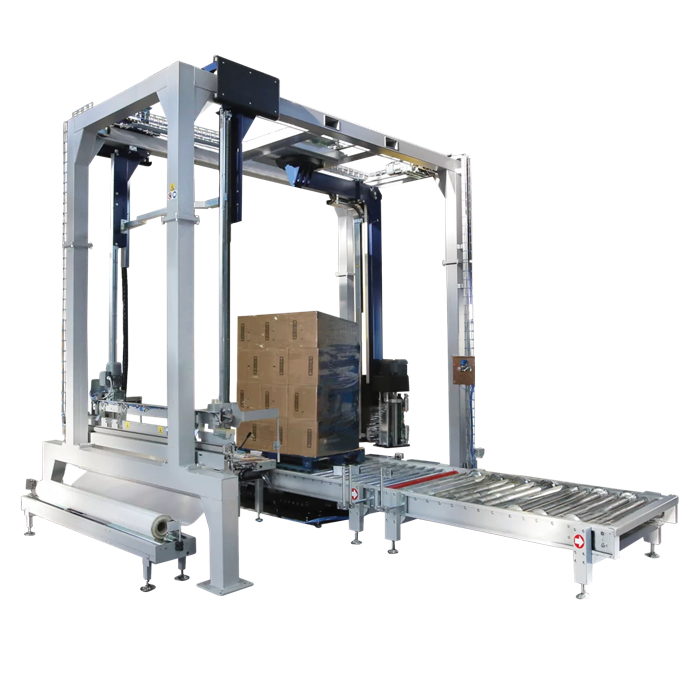

Rotary arm stretch wrapper price guide Australia 2026: cost, throughput, and fit
- What you will pay: Rotary arm stretch wrappers typically run $10,000 to $30,000 for basic models, with advanced and fully automatic inline machines reaching $50,000 or more.
- Why they cost more than a turntable: The load stays still while a powered arm orbits it, which needs a heavier frame and driven arm assembly, but it handles heavy, unstable, and light loads a turntable cannot.
- Throughput is the point: Rotary arm machines commonly wrap 40 to 50 loads an hour, with high-speed models reaching well over 100, against 15 to 30 for a semi-automatic turntable.
- Film is the running cost: A powered pre-stretch carriage elongates film up to 250 to 300%, so one roll covers far more pallets and cuts your cost per load.
- The decision: Match throughput, load type, and film system to your line before you compare price, and choose rotary arm when volume or unstable loads rule out a turntable.
A rotary arm stretch wrapper is the machine that keeps a high-volume dispatch line moving. Instead of spinning the pallet on a turntable, it holds the load still and sweeps a film carriage around it on a rotating arm, which is what lets it wrap heavy, tall, unstable, or very light loads at speed. It costs more than a turntable wrapper, so the question is whether your volume and load types justify the step up. This guide covers what rotary arm wrappers cost in Australia in 2026, the specs that change the price, and how to tell if you need one.
Why automate end-of-line wrapping
End-of-line packaging is where volume meets labour cost. Australian manufacturing generated around $142 billion in industry value added in 2024-25, and transport, postal and warehousing added roughly $110 billion with sales and service income up 7.8% year on year, according to the Australian Bureau of Statistics. More goods through the door means more pallets to wrap, and doing that by hand is slow and hard on the body.
The safety case is real. Safe Work Australia reports body stressing was the single largest cause of serious workers compensation claims, at 50,600 claims or 34.5% of the total, with a median 9.2 weeks off work. Manual pallet wrapping, with its repetitive bending and walking around the load, is exactly the kind of task that drives those injuries. A machine removes the stoop-and-circle entirely, standardises wrap quality so loads arrive intact, and frees a worker for higher-value tasks.
What a rotary arm stretch wrapper costs in Australia
Pricing depends heavily on automation level and speed. Treat the bands below as a price guide for comparison rather than fixed quotes.
| Machine type | Typical price range | Best suited to |
|---|---|---|
| Semi-automatic turntable | $5,000 - $15,000 | Lower volume, stable loads, tight budgets |
| Automatic turntable | $10,000 - $40,000+ | Steady volume with auto film cut and clamp |
| Rotary arm (basic to advanced) | $10,000 - $50,000+ | Heavy, unstable, or light loads at volume |
| Fully automatic inline rotary arm | $40,000 - $100,000+ | High-throughput integrated lines |
A rotary arm machine costs more than a turntable for a reason: the load stays stationary while a powered arm and film carriage orbit it on an overhead boom, which needs a heavier structural frame, a driven arm assembly, and more sophisticated controls. The payoff is the ability to wrap loads that should not or cannot be spun, and to do it faster. Budget for stretch film as an ongoing cost, listing at roughly $100 to $300 a roll, and remember that a good pre-stretch system is the single biggest lever on film cost per pallet. Compare current listings on the rotary arm stretch wrapper and pallet wrapping machine pages, and the stretch wrap film page for consumables.
The specs that decide the price
These are the features to line up when you request quotes:
- Throughput: Rotary arm machines commonly wrap 40 to 50 loads an hour, with high-speed models reaching 120 to 150, against 15 to 30 for a semi-automatic turntable. Size the machine to your peak dispatch rate.
- Rotary arm versus turntable: Choose an arm for heavy loads that cannot be spun, unstable or light loads that would topple on a turntable, and high volumes. A turntable suits stable loads and lower budgets.
- Powered pre-stretch carriage: A motor-driven carriage stretches film up to 250 to 300% before it reaches the load, dramatically cutting film use per pallet. This is a major cost and running-cost differentiator.
- Automatic film cut and clamp: This feature separates fully automatic machines from semi-automatic ones, where an operator still attaches and cuts the film each cycle.
- Control system: PLC control with programmable wrap patterns and a touchscreen lets you tune wraps by load type and repeat them exactly.
- Safety fencing and power: A moving arm needs guarding, and higher-throughput or automatic machines usually need three-phase power rather than single phase. Confirm footprint and supply against your site.
Rotary arm or turntable?
The split comes down to load and volume. A turntable wrapper spins the pallet and is cheaper, which suits stable loads and modest throughput. A rotary arm keeps the load still, so it handles heavy loads that should not be spun, light or unstable loads that would shift on a turntable, and higher volumes at speed. If your loads are awkward or your line is fast, the arm earns its premium. If they are stable and your volume is moderate, a turntable may be all you need.
A realistic scenario
Picture a beverage manufacturer in regional Victoria dispatching 60 pallets a shift of tall, relatively unstable stacked cartons. Their semi-automatic turntable struggles: fast spins risk toppling the loads, so operators slow it down, and a worker still bends to attach and cut film on every pallet.
A rotary arm machine around the $30,000 mark wraps the stationary loads without spinning them, holding stability while lifting throughput to keep pace with dispatch. A powered pre-stretch carriage cuts film use per pallet, and automatic film cut and clamp removes the manual stoop entirely. The payback shows up in fewer damaged loads in transit, lower film spend, and a worker freed from a repetitive strain task. The pallet wrapping machine buying guide works through semi versus fully automatic and how to weigh pre-stretch and throughput.
Frequently asked questions
How much does a rotary arm stretch wrapper cost in Australia?
Basic rotary arm machines generally run $10,000 to $30,000, while advanced and fully automatic inline models reach $50,000 or more. By comparison, semi-automatic turntable wrappers start around $5,000 to $15,000, so the arm is a step up in both capability and price.
What is the difference between a rotary arm and a turntable stretch wrapper?
A turntable wrapper spins the pallet while the film stays in one place. A rotary arm keeps the load stationary and orbits a film carriage around it on a powered arm. The arm handles heavy, tall, unstable, or very light loads that cannot be spun safely, and generally wraps faster.
How many pallets can a rotary arm wrapper handle per hour?
Rotary arm machines commonly wrap around 40 to 50 loads an hour, and high-speed models can reach 120 to 150. Semi-automatic turntables typically manage 15 to 30. Match the machine to your peak dispatch rate so wrapping does not become the bottleneck.
How can I reduce stretch film costs?
A powered pre-stretch carriage is the biggest lever. By elongating the film up to 250 to 300% before it reaches the load, it makes one roll cover far more pallets, cutting cost per load. Programmable wrap patterns also apply only the film each load actually needs.
What matters most
A rotary arm stretch wrapper is a throughput and load-stability decision. Match the wrap speed to your dispatch rate, choose the arm when heavy or unstable loads rule out a turntable, and prioritise a powered pre-stretch carriage to control film cost. Confirm your power supply and floor space before you buy. Get the fit right and the machine pays back in faster dispatch, fewer damaged loads, and a worker off a repetitive task. Buy on the price tag alone and you risk a wrapper that cannot keep up with your line.
Ready to compare throughput, film systems, and pricing on pallet wrapping? Get quotes from rotary arm stretch wrapper suppliers across Australia here.

-160x160-state_article-rel-cat.png)




-205x205.png)