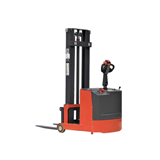
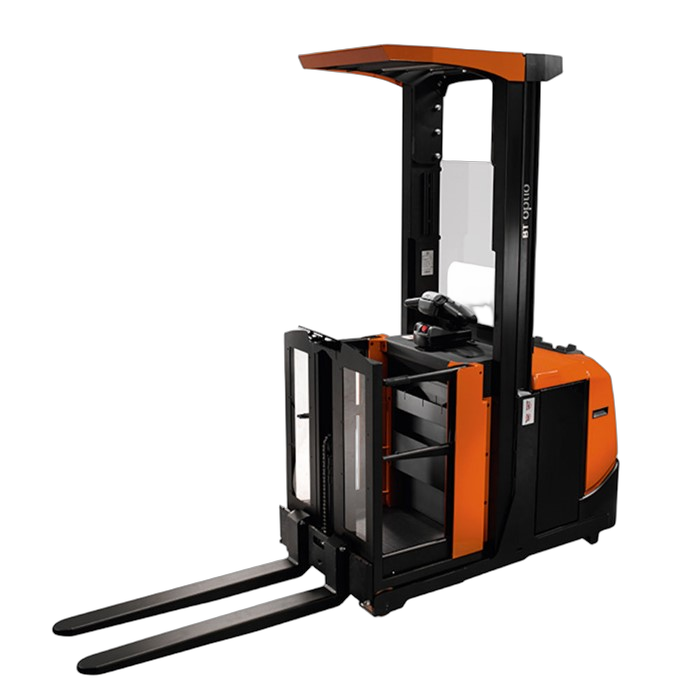

Key takeaways
- Order pickers are built for piece-picking and case-picking: the operator rides up to the pick face and retrieves items by hand from racking.
- Reach trucks are built for full-pallet retrieval: the forks extend into racking to deposit or retrieve entire pallets.
- If your primary task is picking individual items from multi-level racking → order picker. If your primary task is moving full pallets into and out of racking → reach truck.
- New order picker prices (2026 AUD): $35,000-$180,000+. New reach truck prices: $45,000-$150,000+.
- Both require a High Risk Work Licence: LO class for order pickers at height, LF class for reach trucks.
- Reach trucks operate in aisles from 2,700mm. High-level order pickers can work in aisles from 1,500mm with wire guidance.
- Some operations need both: reach trucks to replenish pick faces from reserve stock, order pickers to pick from those faces.
Introduction
Order pickers and reach trucks both operate in narrow-aisle, high-racking warehouse environments - but they solve fundamentally different problems. An order picker lifts the operator to the product for piece or case retrieval. A reach truck lifts entire pallets into and out of racking bays. Choosing the wrong one creates a workflow mismatch that compounds across every shift: an order picker that spends half its time doing pallet put-away work it was not designed for, or a reach truck trying to handle case picks that an operator-up platform does in half the time.
This comparison is directly relevant to Australian DC and fulfilment operations - particularly in western Sydney and Melbourne's south-east - where racking above 6 metres is standard and both order pickers and reach trucks are deployed in the same facilities. The decision between them is about your dominant picking task, not just your racking height.
Operations comparing these two machines:
- 3PL fulfilment centres with both reserve stock and active pick faces
- Large retail DCs transitioning from manual ground-level picking to operator-up systems
- Pharmaceutical distributors evaluating pick rate and compliance trade-offs
- Automotive and industrial parts warehouses with deep racking and high SKU counts
Match the machine to your dominant task
Before evaluating specs, confirm what your operators spend most of their shift doing. Your dominant task type sets the machine type - price and features follow from there.
Factor | Order Picker | Reach Truck |
|---|---|---|
Primary task |
Piece-picking and case-picking from racking |
Full-pallet put-away and retrieval |
Operator position |
Rides up with the platform to pick height |
Stays at ground level, forks extend into racking |
Load handling |
Individual items or cases placed onto pallet on platform |
Full pallets - typically 1,000-2,500 kg |
Pick rate advantage |
50-100+ lines/hour for piece-pick |
15-25 pallets/hour for pallet put-away/retrieval |
If more than 60% of your shift tasks involve picking individual items or cases from multi-level racking → specify an order picker. If more than 60% of your tasks are full-pallet movements → specify a reach truck. Operations with a genuine 50/50 split often deploy both machine types, using the reach truck for pallet replenishment and the order picker for active picking.
Evaluate the key specifications
With your machine type confirmed, these are the specs that determine whether a given model fits your operation.
Specification | Order Picker | Reach Truck |
|---|---|---|
Maximum working height |
Up to 12m+ (operator elevated) |
Up to 12m+ (mast and fork reach) |
Load capacity |
250-1,200 kg (platform load) |
1,000-2,500 kg (pallet on forks) |
Minimum aisle width |
1,500mm (wire-guided) to 2,800mm |
2,700mm-3,200mm |
Travel speed |
6-14 km/h (reduced at height) |
10-14 km/h |
Battery system |
24V-48V, lead-acid or lithium-ion |
36V-80V, lead-acid or lithium-ion |
Licence required |
LO class (order picking forklift) for work at height |
LF class (forklift truck) |
Single/double deep racking |
Single deep standard - not designed for deep reach |
Available in single and double deep configurations |
The most common mistake is specifying a reach truck for a predominantly piece-pick operation because it can also handle pallet work. A reach truck doing case picks adds 30-50% more labour time per line than a purpose-built order picker at the same pick height - the operator must lower the full pallet to ground level, pick from it, then re-shelve it.
Understand the full cost breakdown (2026 prices)
Purchase price is only part of the picture - most cost models that get rejected at approval stage have missed the running cost layer. Here's how the two machine types compare on cost.
Cost Category | Order Picker (AUD) | Reach Truck (AUD) |
|---|---|---|
New mid-spec unit |
$55,000-$120,000 |
$60,000-$120,000 |
New high-spec unit |
$120,000-$180,000+ |
$100,000-$150,000+ |
Used |
$15,000-$60,000 |
$15,000-$55,000 |
Annual maintenance |
$3,000-$6,000 |
$3,500-$7,000 |
Annual energy |
$1,200-$3,500 |
$1,500-$4,000 |
Operator training/licensing |
LO class HRWL: $800-$1,500 per operator |
LF class HRWL: $800-$1,500 per operator |
High-spec order pickers with wire guidance and cab-up platforms carry a higher purchase price than equivalent-height reach trucks - but the ROI gap closes quickly in high-volume picking. An operation picking 300+ lines per shift from racking above 4 metres will typically recover the price premium of an order picker over a reach truck within 6-12 months through reduced labour cost per pick. Get quotes for order pickers and reach trucks to compare delivered pricing for your specific configuration.
Decision framework - order picker vs reach truck
Decision Factor | Order Picker Scores Higher When... | Reach Truck Scores Higher When... |
|---|---|---|
Dominant task |
60%+ of tasks are piece or case picks |
60%+ of tasks are full-pallet movements |
SKU count |
High SKU count with frequent multi-level access |
Lower SKU count with bulk storage |
Aisle width |
Aisles under 2,700mm (wire-guided order picker fits) |
Aisles 2,700mm+ with pallet-width clearance needed |
Racking depth |
Single-deep selective racking |
Double-deep racking requiring pantographic reach |
Order profile |
Many orders with few items each (e-commerce, parts) |
Fewer orders with full-pallet quantities |
Labour cost sensitivity |
High pick rate reduces cost per line picked |
Pallet throughput rate is the key metric, not lines picked |
Versatility |
Picking is the sole or dominant function |
Machine must also handle put-away, replenishment and dock work |
Existing fleet |
Reach trucks already handle pallet work - need a dedicated picker |
No existing fleet - need one machine to cover both tasks |
Evaluate suppliers
You're ready to go to market. Use this checklist to assess each supplier against the same criteria.
Factor | What to Ask |
|---|---|
Application assessment |
Will the supplier conduct a site visit or application review before recommending a model? |
Demo or trial availability |
Can you trial the machine in your actual warehouse environment before committing? |
Delivered price |
What is the total delivered price including battery, charger, safety systems and commissioning? |
Wire guidance |
For order pickers in narrow aisles - is wire guidance included or an optional extra? |
Single vs double deep |
For reach trucks - is a pantographic (double-deep) mast available and what is the upcharge? |
Operator training |
Does the supplier provide LO or LF licence-aligned training as part of the package? |
Warranty and service |
What is covered under warranty? Is a full-service contract available and what does it cost annually? |
Parts availability |
Are critical parts held in Australian stock or imported to order? |
Fleet integration |
Can the supplier provide both machine types from the same fleet management platform? |
State coverage |
Do you have service technicians in NSW, VIC, QLD and WA? |
Frequently asked questions
When should i choose an order picker over a reach truck?
Choose an order picker when more than 60% of your shift tasks are piece-picking or case-picking from multi-level racking. Order pickers deliver 50-100+ lines per hour versus the 15-25 pallet moves per hour a reach truck handles - the labour cost per line is substantially lower for item-level picking.
Can a reach truck do piece picking?
A reach truck can retrieve a pallet so the operator picks from it at ground level, but it cannot position the operator at the pick face the way an order picker does. This ground-level retrieval method adds 30-50% more time per pick line compared to a purpose-built order picker.
Do i need different licences for each machine?
Yes. Order pickers operating at height require an LO class High Risk Work Licence (order picking forklift), while reach trucks require an LF class licence (forklift truck). Both are issued by the relevant state WHS regulator.
What is the cost difference between an order picker and a reach truck?
At mid-spec, both sit in the $55,000-$120,000 range. High-spec wire-guided order pickers reach $180,000+, while top-end reach trucks cap around $150,000. Running costs are broadly similar at $5,000-$10,000 per year.
Can one warehouse need both machines?
Yes - many Australian DCs deploy reach trucks for pallet replenishment from reserve stock into active pick faces, and order pickers to pick from those faces. This split-fleet model is standard in high-volume fulfilment and pharmaceutical distribution.
Summary
- Order pickers are the correct spec for piece-picking and case-picking from multi-level racking
- Reach trucks are the correct spec for full-pallet put-away and retrieval
- The decision is driven by dominant task type, not racking height alone
- High-volume picking operations (300+ lines per shift) recover the order picker premium within 6-12 months
- Separate licences required: LO class for order pickers, LF class for reach trucks
- Many DCs deploy both machine types in a split-fleet configuration
Most buyers shortlist 2-4 models after getting a quote - if you're within 90 days of a fleet decision, start the comparison now.
Don't waste time contacting suppliers individually. IndustrySearch gives you direct access to verified Australian order picker and reach truck suppliers - where industrial buyers request and compare multiple quotes so they can buy with confidence.
- Get quotes for order pickers - contact multiple verified suppliers with a single enquiry
- Compare models - filter by capacity, configuration and region
- Contact suppliers directly - speak to specialists who service your state
→ Get and compare order picker quotes now → https://www.industrysearch.com.au/buy/order-picker

-160x160-state_article-rel-cat.png)




-160x160-state_article-rel-cat.png)