
Key takeaways
- New 5 tonne forklift prices (2026 AUD): diesel $50,000-$90,000, LPG $45,000-$80,000, electric $70,000-$130,000.
- Fuel type sets your operating cost floor: diesel costs $8-$15/hour in fuel, LPG $6-$12/hour, electric $2-$5/hour in charging - but electric adds $15,000-$40,000 to the purchase price.
- If your operation is indoor-only with single-shift use → electric. If outdoor, multi-shift or remote site → diesel or LPG.
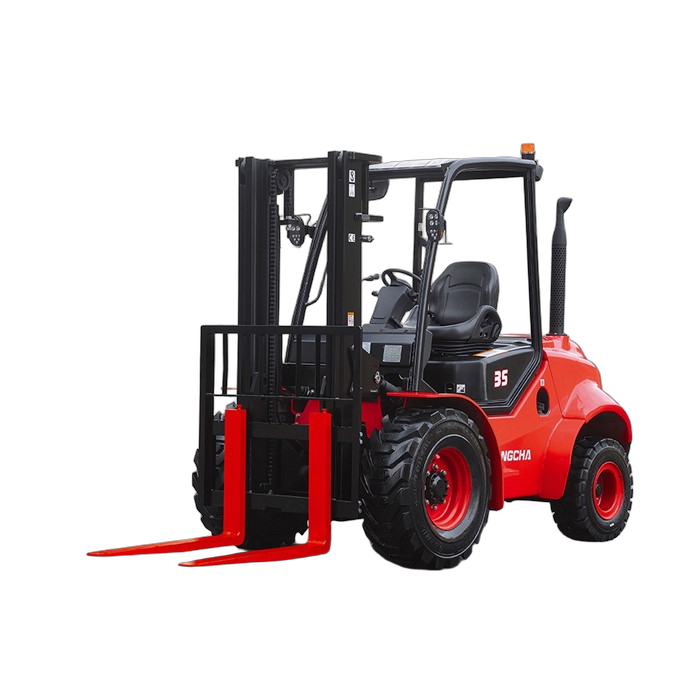
- Configuration types: counterbalance (standard), rough terrain (construction, quarry), container handler (ports, logistics yards). Each has a different price bracket and specification set.
- All operators require a High Risk Work Licence (LF class) issued by the state WHS regulator. No exemptions for private property.
- Aisle width and floor load rating are the two most commonly overlooked specifications - a 5 tonne forklift fully loaded can exceed 9 tonnes total weight on the floor.
- 5 tonne forklifts from verified Australian suppliers are available on IndustrySearch.
Introduction
A 5 tonne forklift is the standard specification for operations handling heavy pallets, loaded containers, steel, timber and bulky manufactured goods that exceed the capacity of a standard 2.5-3 tonne machine. In Australia in 2026, demand for 5 tonne units is concentrated in manufacturing, construction, timber yards, logistics hubs and mining support operations - environments where pallet weights regularly sit between 3 and 5 tonnes and the machine needs to work across mixed surfaces, outdoor yards or high-duty shift patterns.
This guide walks you through the three decisions that set your price: fuel type, configuration and the key specifications that separate a machine that fits your operation from one that costs more to fix than it saves. If you are comparing supplier quotes, get quotes for 5 tonne forklifts on IndustrySearch to benchmark pricing from multiple verified suppliers. For a deeper breakdown of forklift operating costs by fuel type, see the LPG forklift buying guide on IndustrySearch.
Operations that typically specify a 5 tonne forklift:
- Steel and building materials distributors handling heavy bundled loads
- Timber yards and sawmills moving green and treated timber packs
- Container freight stations and logistics yards loading and unloading FCL shipments
- Manufacturing plants with heavy raw material inputs (glass, concrete products, metals)
- Construction sites and civil contractors requiring rough terrain material handling in QLD and WA
Choose your fuel type
Before specifying anything else, confirm which fuel type matches your operating environment. Your choice here sets your purchase price bracket, hourly running cost and the compliance obligations that follow.
Fuel Type | Purchase Price (AUD) | Best For |
|---|---|---|
Diesel |
$50,000-$90,000 |
Outdoor yards, rough terrain, multi-shift, remote sites, construction |
LPG |
$45,000-$80,000 |
Mixed indoor/outdoor, ventilated warehouses, sites with existing LPG supply |
Electric (lithium-ion or lead-acid) |
$70,000-$130,000 |
Indoor warehouses, food-grade environments, zero-emission requirements, single-shift |
If your forklift operates outdoors more than 50% of the time, on unsealed surfaces, or across multi-shift patterns without charging downtime tolerance → diesel is the default specification. If the machine is indoor-only with single-shift use and charging infrastructure → electric delivers lower five-year TCO despite the higher purchase price. LPG covers the middle ground where the site is mixed indoor/outdoor and adequate ventilation can be maintained for CO exposure compliance.
When to choose diesel
Diesel is the correct specification when the forklift works outdoors, on rough terrain, across extended shifts or on remote sites where charging infrastructure does not exist. Diesel 5T units deliver the highest torque and are available in rough terrain configurations with 4WD, high-clearance axles and pneumatic tyres for construction and quarry sites.
When to choose electric
Electric is the correct specification for indoor-only operations with smooth concrete floors, noise-sensitive environments and food-grade or pharmaceutical facilities where emissions are prohibited. Lithium-ion batteries add $15,000-$25,000 over lead-acid but charge in 1-2 hours and eliminate watering and equalisation requirements. For multi-shift indoor operations, lithium-ion justifies the premium within the first 18 months through reduced downtime.
Evaluate the key specifications
With your fuel type confirmed, these are the specifications that determine whether a given 5 tonne model fits your operation.
Specification | Typical Range | Buyer Consideration |
|---|---|---|
Lift height |
3.0-7.0 m (standard mast), up to 8.0 m+ (triple-stage) |
Capacity at height reduces - a 5T rated machine may only lift 3.5T at 6 metres. Confirm rated capacity at your maximum rack height. |
Load centre |
500 mm (standard) or 600 mm |
Non-standard pallet sizes or long loads may require 600 mm load centre - this reduces effective capacity by 10-20% |
Tyre type |
Cushion (indoor), pneumatic (outdoor), solid pneumatic (mixed) |
Cushion tyres on rough surfaces cause premature wear and stability risk. Pneumatic on smooth indoor floors reduces traction and increases noise. |
Turning radius |
2,800-3,800 mm |
5T machines need wider aisles than 3T units - confirm your aisle width accommodates the turning circle with a loaded pallet |
Total machine weight |
4,500-7,500 kg (unladen) |
Fully loaded, a 5T forklift puts 9-12 tonnes on the floor - confirm your floor, dock and ramp load ratings |
Attachments |
Side shift, fork positioner, paper roll clamp, bale clamp, rotator |
Attachments reduce effective capacity by 5-15% depending on weight and load centre shift |
Understand the full cost breakdown (2026 prices)
Purchase price is only part of the picture - most cost models that get rejected at approval stage have missed the running cost layer. Here is the full breakdown.
Category | Cost Range (AUD) | Typical Configuration |
|---|---|---|
New diesel 5T |
$50,000-$90,000 |
Counterbalance, pneumatic tyres, 4.5 m mast, side shift |
New LPG 5T |
$45,000-$80,000 |
Counterbalance, cushion or solid pneumatic, 4.5 m mast, side shift |
New electric 5T |
$70,000-$130,000 |
Counterbalance, 80V lithium-ion, cushion tyres, 4.5 m mast |
Used 5T (all fuel types) |
$15,000-$50,000 |
Price depends on hours, fuel type, tyre condition and service history |
Annual fuel/energy (single shift) |
Diesel $12,000-$22,000 | LPG $9,000-$18,000 | Electric $3,000-$7,000 |
8 hours/day, 5-6 days/week |
Annual maintenance |
Diesel $5,000-$10,000 | LPG $4,500-$9,000 | Electric $2,500-$5,000 |
Scheduled servicing, filters, fluids, brake inspection, tyre replacement |
Tyre replacement (annual) |
$2,000-$5,000 |
Pneumatic tyres on rough surfaces need replacing every 1,500-2,500 hours |
Hire rate |
$500-$1,200/week |
Diesel units at the lower end, electric at the upper - short-term rates higher |
The most common mistake is specifying diesel for an indoor-only operation because the purchase price is lower. Over five years, a diesel 5T running single-shift indoors costs $45,000-$80,000 more in fuel and maintenance than an electric equivalent - more than enough to offset the $20,000-$40,000 electric purchase premium. For an outdoor diesel unit at $70,000 running 2,000 hours per year, the break-even against hiring at $900/week typically occurs within 18-24 months. Get quotes for 5 tonne forklifts to compare delivered pricing before finalising your business case.
Plan the asset - depreciation and financing
The ATO assigns an effective life of 10 years for forklifts. Under diminishing value, the depreciation rate is 20%. Under prime cost, it is 10%. The current instant asset write-off threshold of $20,000 (2026 financial year) does not cover most new 5T units, so the standard depreciation schedule or a chattel mortgage structure applies. For a full breakdown of equipment finance options, see the used forklift finance guide on IndustrySearch.
Chattel mortgage gives immediate ownership and GST recovery on the next BAS. For operations where utilisation is unproven or contract-based, an operating lease with a 12-month exit clause limits capital exposure. Residual values for well-maintained 5T diesel forklifts at 8-10 years sit at 15-25% of purchase price. Electric units hold value slightly better due to lower wear on drivetrain components.
Evaluate suppliers
You are ready to go to market. Use this checklist to assess each supplier against the same criteria.
Factor | What to Ask |
|---|---|
Application assessment |
Will the supplier conduct a site visit or load assessment before recommending a model? |
Delivered price |
Total price including mast, attachments, tyres and delivery to site? |
Warranty |
Warranty period for engine/motor, transmission, mast, hydraulics and battery (electric)? |
Service contract |
Is a full-service maintenance contract available? What does it include per service visit and what is the annual cost? |
Parts availability |
Are common wear parts (tyres, filters, brake pads, hydraulic seals) held in Australian stock? |
Lead time |
Current delivery lead time for new units? Are ex-rental or demo units available sooner? |
Operator training |
Does the supplier provide LF-aligned operator training as part of the purchase or hire package? |
Hire-to-own pathway |
Can hire payments be credited toward purchase if you convert within 6-12 months? |
State service coverage |
Do you have service technicians in our state? What is the standard breakdown response time? |
Used unit history |
For used units: full service records, hour meter verification, tyre condition and remaining engine/battery life? |
Frequently asked questions
How much does a new 5 tonne forklift cost in Australia?
New 5 tonne forklifts range from $45,000-$80,000 for LPG, $50,000-$90,000 for diesel and $70,000-$130,000 for electric in 2026 AUD. The primary price driver is fuel type, followed by mast height and attachment specification.
When should i choose diesel over electric for a 5T forklift?
Choose diesel when the forklift works outdoors more than 50% of the time, on rough or unsealed surfaces, across multi-shift operations, or on remote sites without charging infrastructure. Electric delivers lower TCO only when the machine operates indoor-only on smooth floors with single-shift charging windows.
What licence do operators need for a 5 tonne forklift in Australia?
All operators require a High Risk Work Licence, LF class (forklift truck), issued by the relevant state WHS regulator. This applies on all sites including private property - there are no exemptions based on location or ownership.
What floor load rating does a 5T forklift require?
A 5 tonne forklift weighs 4,500-7,500 kg unladen. Fully loaded, total weight on the floor reaches 9-12.5 tonnes concentrated across four small tyre contact patches. Confirm your warehouse floor, dock plates and ramps are rated for this point load before taking delivery.
What are typical annual running costs for a 5T diesel forklift?
Annual running costs for a 5T diesel on single shift total $19,000-$37,000 covering fuel, scheduled maintenance and tyre replacement. Two-shift operations should budget $35,000-$55,000 per machine before unplanned repairs and operator costs.
What matters most
- Fuel type is the primary cost driver - electric costs $20,000-$40,000 more upfront but saves $45,000-$80,000 in running costs over five years vs diesel for indoor use
- Diesel is the correct spec for outdoor, rough terrain, multi-shift and remote operations
- A fully loaded 5T forklift puts 9-12 tonnes on the floor - confirm floor and dock ratings before purchase
- 5T machines need wider aisles than 3T units - confirm turning radius against your layout
- All operators require an LF class High Risk Work Licence with no exemptions
- Buying breaks even against hiring at $900/week within 18-24 months for a $70,000 diesel unit
Most buyers shortlist 2-4 models after getting a quote - if you are within 60 days of purchasing, start the comparison now.
Don't waste time contacting suppliers individually. IndustrySearch gives you direct access to verified Australian 5 tonne forklift suppliers - where industrial buyers request and compare multiple quotes so they can buy with confidence.
- Get quotes for 5 tonne forklifts - contact multiple verified suppliers with a single enquiry
- Compare models - filter by fuel type, capacity and region
- Contact suppliers directly - speak to specialists who service your state
→ Get and compare 5 tonne forklift quotes now → industrysearch.com.au/buy/5-ton-forklift

-160x160-state_article-rel-cat.png)




-160x160-state_article-rel-cat.png)