
Key takeaways
Machine | What It Does | Where It Sits on the Line |
|---|---|---|
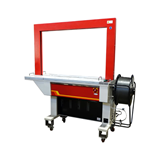
Carton sealer |
Closes and tapes or glues the top flaps of a packed carton |
End of line — after packing |
Case erector |
Opens flat-packed carton blanks and seals the base ready for filling |
Start of line — before packing |
Case packer |
Places product into the open carton automatically |
Mid-line — between erector and sealer |
Typical price range |
Sealer: $3,500–$60,000 | Erector: $8,000–$80,000 | Packer: $40,000–$300,000+ |
Case packer is the largest capital investment of the three |
Do you need all three? |
Not always — many operations run a sealer only, or erector + sealer without a packer |
Start with what your bottleneck actually is |
Common mistake |
Buying a case packer before the line volume justifies it |
ROI requires consistent high-volume, uniform product flow |
Three different machines, three different jobs — here's what each one does
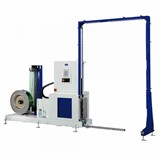
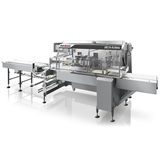
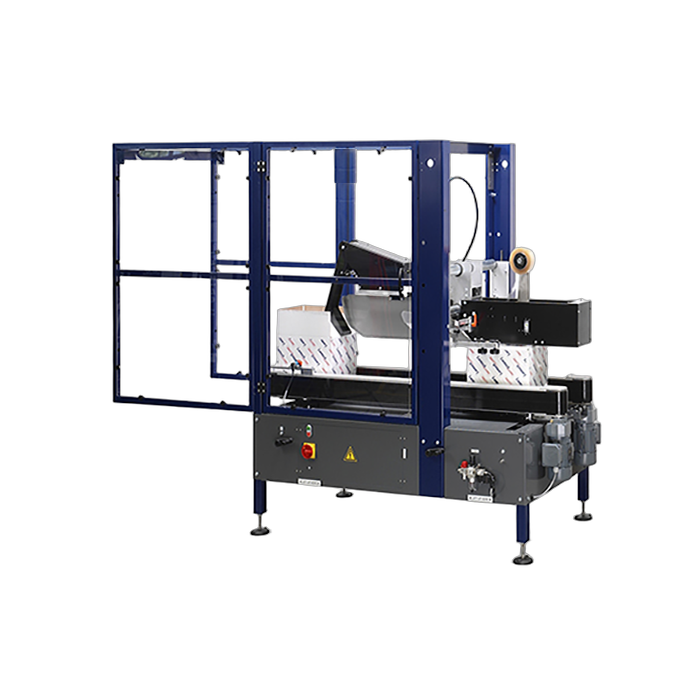
A carton sealer closes the top of a carton that has already been packed — folding the flaps and applying tape or hot-melt glue to create a secure, dispatch-ready seal. A case erector does the opposite end of the job: it takes flat-packed carton blanks, opens them into box form and seals the base so they're ready to receive product. A case packer sits between the two — it takes product from upstream and places or wraps it into the open carton automatically, replacing the manual packing step entirely.
These three machines are often discussed together because they form a complete end-of-line automation sequence, but most Australian operations don't need all three from day one — and buying the wrong one first is one of the most common capital mistakes in packaging line investment. This guide clarifies what each machine does, where it fits on the line, what it costs, and how to identify which one your operation actually needs first. Browse carton sealers and case erectors from verified Australian suppliers on IndustrySearch to compare models alongside this guide.
This comparison is relevant across:
- Food and beverage manufacturers evaluating end-of-line automation for the first time
- FMCG and consumer goods producers with manual packing or sealing bottlenecks
- E-commerce and distribution operations sealing 200+ cartons per shift
- Contract packers adding equipment for a new client category or product type
- Production managers building a capital equipment investment roadmap
- Operations currently using all three machines manually and modelling the automation ROI
Understand what each machine does and where it fits
Before evaluating cost or configuration, confirm where each machine sits on the line and what problem it solves. The sequence below is how a fully automated carton line runs — from flat blank to sealed dispatch-ready carton.
Stage | Machine | What It Does | Replaces |
|---|---|---|---|
1. Box formation |
Case erector |
Opens flat carton blank, squares it and seals the base with tape or glue |
Manual box opening and base taping by an operator |
2. Product packing |
Case packer |
Loads product into the open carton — drop-in, side-load or wrap-around depending on product type |
Manual product placement into cartons by operators |
3. Carton closing |
Carton sealer |
Folds top flaps and seals with tape or hot-melt glue; carton exits dispatch-ready |
Manual top taping by an operator with a tape gun |
Most operations automate Stage 3 first — the carton sealer is the lowest cost entry point and delivers fast payback. Stage 1 is typically automated second when box formation becomes a bottleneck. Stage 2 (the case packer) is the most capital-intensive step and only delivers ROI at sustained high volume with consistent product and carton geometry. Once you understand where each machine sits, move to Step 2 to evaluate the performance differences.
Evaluate the key differences between each machine
With the line sequence confirmed, these are the specifications and operational factors that distinguish each machine type and determine which one your operation needs first.
Factor | Carton Sealer | Case Erector | Case Packer |
|---|---|---|---|
Function |
Closes and seals filled carton top |
Forms and base-seals empty carton |
Loads product into open carton |
Speed range |
15–40 cartons/min |
10–40 cartons/min |
5–30 cartons/min (product dependent) |
Purchase price (new) |
$3,500–$60,000 |
$8,000–$80,000 |
$40,000–$300,000+ |
Complexity |
Low — mechanically simple |
Medium — carton blank handling and squaring |
High — product handling, orientation and placement |
Carton size flexibility |
High — random-size models handle variable dimensions |
Medium — adjustable within a range; changeover required |
Low — typically configured for specific carton and product geometry |
Sealing method |
Pressure-sensitive tape or hot-melt glue |
Hot-melt glue (base) or tape |
Not applicable — packing only, no sealing |
Operator requirement |
Minimal — monitor and tape replenish |
Minimal — blank hopper loading |
Low for full-auto; higher for semi-auto models |
Payback period |
6–18 months at 200+ cartons/shift |
12–24 months at medium–high volume |
24–48 months — requires sustained high volume |
Understand the cost differences (2026 prices)
Purchase price is only part of the picture — the consumable and maintenance cost profile of each machine differs significantly, and the case packer's complexity means its running costs scale differently from the sealer and erector.
Cost Factor | Carton Sealer | Case Erector | Case Packer |
|---|---|---|---|
Purchase price — entry |
$3,500–$8,000 |
$8,000–$20,000 |
$40,000–$80,000 |
Purchase price — mid |
$8,000–$35,000 |
$20,000–$50,000 |
$80,000–$180,000 |
Purchase price — high-spec |
$35,000–$60,000 |
$50,000–$80,000 |
$180,000–$300,000+ |
Primary consumable |
Tape: $2,000–$12,000/year |
Hot-melt glue: $1,500–$6,000/year |
Minimal — no primary consumable |
Annual maintenance |
$500–$3,500 |
$1,500–$6,000 |
$8,000–$25,000 |
Used / refurbished |
$2,000–$15,000 |
$5,000–$25,000 |
$20,000–$100,000 |
Pricing reflects 2026 Australian market conditions. The case packer's maintenance cost is the most significant operating cost difference between the three machines — its product handling and orientation systems require significantly more servicing than the mechanically simpler sealer or erector. For a detailed breakdown of case packer pricing and ROI modelling, see the IndustrySearch case packer price guide.
Step 4: Decision framework — which machine do you actually need first?
The most useful output of this comparison is knowing which machine to invest in first. Match your situation to the right column.
Your Situation | Start With | Why |
|---|---|---|
Operators taping cartons shut manually at end of line |
Carton sealer |
Lowest cost entry point, fastest payback, no upstream disruption |
Box opening and base taping is the bottleneck, not the sealing |
Case erector |
Removes the formation bottleneck without requiring a full line reconfiguration |
Manual packing operators are the constraint at high, consistent volume |
Case packer |
Replaces the most labour-intensive step; ROI requires 24–48 months at sustained volume |
Volume is growing but not yet consistent |
Carton sealer first, erector second |
Build automation incrementally — avoid committing to a case packer before the volume is proven |
Running multiple SKUs with different carton sizes regularly |
Random-size carton sealer |
Handles variable dimensions without changeover; case packer is difficult to justify across multiple SKUs |
Single product, uniform carton, high daily volume (1,000+ cartons/shift) |
Full line: erector + packer + sealer |
Full automation ROI is achievable; invest in line integration from the outset |
Budget is the primary constraint |
Carton sealer |
$3,500–$35,000 range delivers automation value without major capital commitment |
Evaluate suppliers
You're ready to go to market. Use this checklist for whichever machine type you're investing in first — the questions adapt across all three.
Factor | What to Ask |
|---|---|
Carton size compatibility |
What is the minimum and maximum carton size this machine handles at rated speed? |
Product compatibility (case packer) |
Has this machine been validated for my product type, shape and weight at my target speed? |
Sealing method |
Does this machine use tape or hot-melt glue, and which is better suited to my carton board specification? |
Changeover time |
How long does a carton size changeover take at my SKU mix, and is it tool-free? |
Line integration |
Can this machine integrate with my existing conveyor, upstream and downstream equipment? |
Future-proofing |
If I add the next machine in the sequence later, is this machine designed to integrate with it? |
Consumable sourcing |
Am I locked to your tape or glue supply, or can I source consumables independently? |
Local service coverage |
Do you have service technicians in my state, or is support remote or contracted out? |
Spare parts availability |
Are wear components, heads and drive parts stocked locally or imported to order? |
ROI modelling support |
Can you provide a payback model at my current volume and wage rate before I commit? |
Frequently asked questions
Do i need all three machines?
Not necessarily — many Australian operations run a carton sealer only, or a case erector combined with a sealer, without a case packer. A case packer only delivers ROI at sustained high volume with consistent product and carton geometry; below 500–1,000 cartons per shift it is difficult to justify against the capital and maintenance cost.
Which machine should i invest in first?
For most operations, the carton sealer is the right starting point — it is the lowest cost, fastest payback and least disruptive to implement. If box opening is the documented bottleneck rather than sealing, a case erector comes first. Reserve the case packer for when volume is proven, consistent and the manual packing step is clearly the production constraint.
Can these machines handle different carton sizes?
Carton sealers have the most flexibility — random-size automatic models adjust to variable dimensions without manual changeover. Case erectors require a mechanical adjustment between carton sizes, typically taking 10–30 minutes. Case packers are the least flexible and are generally configured for a specific carton and product geometry — they are not well-suited to high-SKU operations with frequent changeover.
What compliance requirements apply to these machines in Australia?
All three machines are classified as plant under the WHS Act 2011 and must comply with AS 4024 machinery safety standards, including guarding of pinch points, rotating components and blade mechanisms. A risk assessment is required before operation, and annual inspection by a competent person is standard practice across most Australian food and FMCG operations.
Summary
- The carton sealer closes cartons at end of line — the lowest cost, fastest-payback entry point to end-of-line automation
- The case erector opens and base-seals carton blanks at the start of the line — invest here when box formation is the documented bottleneck
- The case packer places product into cartons automatically — the highest capital cost and longest payback; only justifiable at sustained high volume with uniform product
- Most operations should start with a carton sealer and add upstream automation as volume grows — not the other way around
- All three machines are classified as plant under AS 4024 and WHS Act 2011 — risk assessment and annual inspection are non-negotiable compliance requirements
- Tape consumables (sealer) and hot-melt glue (erector) are the primary recurring costs — source independently of your machine supplier to control long-term TCO
Ready to compare models?
Don't waste time contacting suppliers individually. IndustrySearch gives you direct access to verified Australian packaging machinery suppliers — compare carton sealers, case erectors and case packers in one place, then request quotes from suppliers best matched to your operation.
- Compare models — filter by machine type, throughput and region
- Request quotes — contact multiple verified suppliers with a single enquiry
- Contact suppliers directly — speak to specialists who service your state
→ Compare Carton Sealers on IndustrySearch | Compare Case Erectors on IndustrySearch


-160x160-state_article-rel-cat.png)