
Key takeaways
- What you will pay: All terrain forklifts typically list from $30,000 to $80,000, averaging around $55,000. A 2.5 tonne 2WD unit starts near $28,000, while a 5 tonne 4WD runs $60,000 to $80,000.
- 2WD or 4WD: 4WD adds roughly $8,000 to $15,000 but is what lets the machine work soft, muddy, or graded ground.
- Licence required: A forklift needs a high-risk work licence, class LF, unlike a pallet jack, so factor operator licensing into the plan.
- Buy or hire: Rough terrain forklifts hire from around $270 to $460 a day, which suits short projects over a full purchase.
- The decision: Match capacity, drive, and tyres to your ground and loads first, then weigh a masted forklift against a telehandler before you compare price.
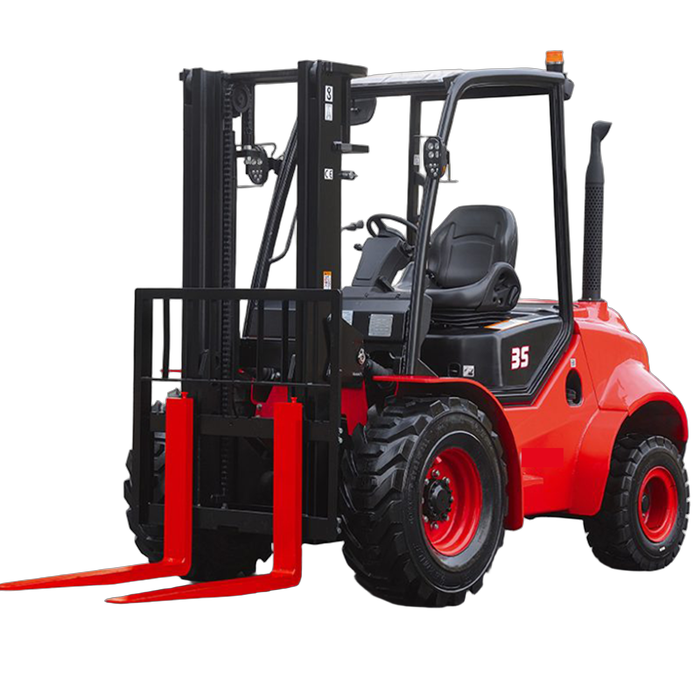
An all terrain forklift is built to do outside what a warehouse forklift cannot: lift heavy loads across mud, gravel, slopes, and rough ground on a construction site, farm, or timber yard. Its big pneumatic tyres, high ground clearance, and often four-wheel drive are what set it apart, and they are also what set the price. This guide covers what all terrain forklifts cost in Australia in 2026, the specs that change the number, and how to choose between drive types and against a telehandler.
Why rough terrain lifting is its own category
The demand sits in Australia's biggest outdoor industries. Construction generated around $177,146 million in industry value added in 2023-24 and employs roughly 1.29 million people, according to the Australian Bureau of Statistics, while agriculture, fisheries, and forestry production reached about $100.3 billion in 2024-25, per ABARES. Those sites move heavy materials over ground a standard forklift simply cannot handle.
Safety is central to the case. Safe Work Australia reports a vehicle was involved in about 66% of the 188 worker fatalities in 2024, and being hit by moving objects drove 23,400 serious workers compensation claims. Mobile plant like forklifts sits at the centre of that risk, which is why the right machine, matched to the ground and properly operated, is as much a safety decision as a productivity one. The correct forklift keeps loads stable on slopes and uneven surfaces where a warehouse unit would be dangerous.
What an all terrain forklift costs in Australia
Price scales with capacity and drive. Treat the bands below as a price guide for comparison rather than fixed quotes.
| Configuration | Typical price range (new) | Best suited to |
|---|---|---|
| 2.5 tonne, 2WD | $28,000 - $35,000 | Firmer sites, lighter loads |
| 3.5 tonne, 2WD | $32,000 - $40,000 | General construction and yards |
| 2.5 to 3.5 tonne, 4WD | $40,000 - $55,000 | Soft, muddy, or graded ground |
| 5 tonne, 4WD | $60,000 - $80,000 | Heavy loads on rough terrain |
| Telehandler (adjacent category) | $50,000 - $150,000 | Reach and height as well as lift |
The all terrain forklift category on the marketplace averages around $55,000, and used units typically sell at 40 to 60% of new. A telehandler, which swaps the fixed mast for a telescopic boom, costs roughly two to four times as much to buy and about twice as much to run, so it only earns its place when you genuinely need reach and height. Budget for total cost of ownership, not just the price tag: annual running costs on an all terrain forklift commonly fall around $10,500 to $22,000 once fuel, servicing, and tyres are counted. If you only need a machine for a single project, hire is worth weighing, with 3 to 4 tonne rough terrain units renting from about $270 to $370 a day. Compare current listings on the all terrain forklift and rough terrain forklift pages.
The specs that decide the price
These are the numbers to compare when you request quotes:
- Load capacity: Rated at a set load centre, commonly 2.5, 3.5, 5, or 7 tonnes. Match it to your heaviest regular load with margin, and remember capacity derates as the load centre moves out.
- 2WD versus 4WD: Two-wheel drive is cheaper and fine for firmer ground, while four-wheel drive is what you need for soft, muddy, or sloping sites. This is the biggest single price lever.
- Tyre type: Large pneumatic tractor-tread tyres give traction and cushioning, while solid or foam-filled tyres resist punctures on debris-heavy sites like brickyards and demolition.
- Ground clearance and lift height: High clearance is the defining feature for uneven ground, and masted units typically lift around 3 to 6 metres.
- Engine and mast: Diesel power and emissions compliance matter for running cost, and a two-stage mast is rugged and simple while a three-stage adds reach.
- Cabin and safety: Look for ROPS roll-over and FOPS falling-object protection, essential on outdoor and overhead-hazard sites.
- Attachments: Side-shift, fork positioners, jibs, and work platforms extend what one machine can do, so check quick-hitch compatibility.
Matching the machine to your site
The costly mistakes come from buying on capacity alone and ignoring the ground. Walk your site, think about the wettest and roughest conditions it sees, and decide whether you need reach as well as lift before you shortlist machines.
A realistic scenario
Consider a landscaping supply yard in regional Queensland that loads pallets of turf, pavers, and bagged product onto customer trucks across an unsealed yard that turns to mud after rain. A cheap 2WD unit was getting bogged and chewing up time.
A 3.5 tonne 4WD all terrain forklift around the $50,000 mark handles the wet ground, carries the yard's heaviest pallet with margin, and runs pneumatic tyres for traction. The owner budgets for an LF licensed operator and factors annual servicing and tyres into the cost. A telehandler was considered but ruled out: the yard needs lift and traction, not boom reach, so the extra outlay was not justified. To weigh the two machine types properly, the telehandler versus all terrain forklift guide compares capacity, reach, and running costs, and the telehandler category shows where the reach option starts.
Frequently asked questions
How much does an all terrain forklift cost in Australia?
All terrain forklifts generally list from $30,000 to $80,000, averaging around $55,000. A 2.5 tonne 2WD unit starts near $28,000, a 3.5 tonne around $32,000 to $40,000, and a 5 tonne 4WD runs $60,000 to $80,000. Used machines typically sell at 40 to 60% of new.
Do you need a licence to operate an all terrain forklift?
Yes. Operating a masted forklift in Australia requires a high-risk work licence, class LF, because it has a mast and elevating load carriage. This is different from a pallet jack, which needs no licence. Telehandler licensing depends on configuration and state rules, so check your local regulator.
What is the difference between an all terrain forklift and a telehandler?
An all terrain forklift uses a fixed mast to lift loads straight up, typically to around 3 to 6 metres. A telehandler uses a telescopic boom that reaches up and out, so it costs roughly two to four times more to buy. Choose a telehandler only when you need reach and height, not just lift.
Should I choose 2WD or 4WD?
Two-wheel drive is cheaper and works on firmer, more predictable ground. Four-wheel drive costs roughly $8,000 to $15,000 more but is essential for soft, muddy, or sloping sites where a 2WD unit would lose traction or get bogged. Match the drive to the worst conditions your site sees.
What matters most
An all terrain forklift is a site-fit decision before it is a price decision. Match the capacity to your heaviest load, the drive and tyres to your ground, and the safety cabin to your hazards, then decide whether a masted forklift or a telehandler suits the job. Factor in an LF licensed operator and the running costs, and weigh hire for short projects. Get the fit right and the machine works where a warehouse forklift cannot. Get it wrong and it sits bogged or overloaded.
Ready to match capacity, drive, and tyres to your site and compare pricing? Get quotes from all terrain forklift suppliers across Australia here.

-160x160-state_article-rel-cat.png)




-160x160-state_article-rel-cat.png)