
Key takeaways
- System price range: New robotic welders in Australia typically cost $80,000-$300,000 depending on payload, reach and welding process.
- Payload drives configuration: A 6 kg payload arm suits light fabrication and sheet metal; 20 kg+ is required for heavy structural and multi-torch setups.
- Decision shortcut: If your operation welds the same joint on 50+ identical parts per shift, a robotic welder will outperform manual welding on cost-per-weld within 12 months.
- Welding process match: MIG robotic welders handle 80% of general fabrication; TIG systems are required for thin-wall stainless, aluminium and aerospace-grade joints.
- Cell footprint: A standard single-arm robotic welding cell requires 3 m x 3 m minimum floor space plus safety fencing clearance.
- Compliance baseline: All robotic welding cells in Australia must be risk-assessed under AS/NZS 4024.1 (Safety of machinery) and comply with WHS Act 2011 PCBU obligations.
- Part fit-up tolerance: Incoming part variation degrades weld quality regardless of robot spec - assess your fabrication tolerances before specifying repeatability.
- Lead times: Australian-stocked standard cells ship in 4-8 weeks; custom-integrated systems run 12-20 weeks from order to commissioning.
Why Australian manufacturers are investing in robotic welders
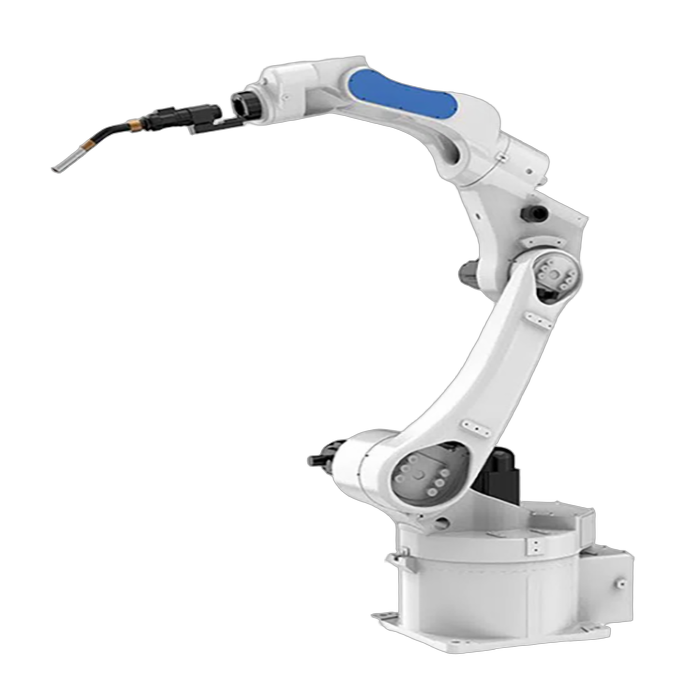
A robotic welder is an industrial robotic arm fitted with a welding torch, wire feeder and integrated power source that executes pre-programmed weld paths with repeatable precision. Australian fabrication operations are adopting robotic welding at an accelerating rate in 2026, driven by a structural shortage of qualified welders and the need to hold throughput targets without scaling headcount.
This guide walks you through configuration, specification and supplier evaluation to select the right robotic welder. If you are comparing robotic welder models on IndustrySearch, getting quotes early locks in current pricing before Q3 demand cycles tighten availability.
Operations that typically invest in robotic welders include:
- Automotive component manufacturers running batch sizes above 100 units per shift
- Structural steel fabricators producing repetitive beam and plate connections
- Agricultural equipment manufacturers welding frames and implement arms
- Mining and resources shops with high-volume wear part production
- General engineering workshops looking to free skilled welders from repetitive joints
Choose your configuration
Before costing anything, confirm which configuration suits your production line. This choice sets your price bracket and most specs that follow.
Type | Key Spec | Best For |
|---|---|---|
Single-arm MIG cell | 6-20 kg payload, 1,400-2,000 mm reach | General fabrication, batch production of brackets, frames and enclosures |
Multi-station rotary cell | Dual positioner, single or twin arm | High-throughput lines where loading and welding run simultaneously |
TIG robotic cell | Precision torch, seam tracking | Thin-wall stainless, aluminium, pressure vessel and aerospace |
Gantry-mounted system | Extended linear travel 3-10 m+ | Large structural assemblies, shipbuilding, heavy transport manufacturing |
If your operation welds mild steel parts under 1.5 m and runs batches above 50 units, a single-arm MIG cell is the default. If you cannot afford load/unload downtime, move to a multi-station rotary configuration.
When to choose a single-arm MIG cell: Your work is primarily mild steel or galvanised steel, parts fit within a 1,400 mm reach envelope, and batch sizes justify programming time. This covers roughly 70% of Australian installations. For guidance on selecting the right MIG welder power source, match amperage to your dominant material thickness.
When to choose a TIG or gantry system: Your application demands weld quality certification (pressure vessels, defence, aerospace) or part geometry exceeds 2 m. TIG cells cost 30-50% more than MIG setups. The next step covers the specifications that determine model fit.
Evaluate the key specifications
With your configuration confirmed, these specs determine whether a given robotic welder fits your production requirements.
Specification | Typical Range | Buyer Consideration |
|---|---|---|
Payload capacity | 6-25 kg | Must cover torch, wire feeder, sensor and any multi-tool head combined |
Reach | 1,400-2,010 mm | Measure the furthest weld point from the robot base on your largest part - add 200 mm clearance |
Repeatability | +/-0.04-0.08 mm | Tighter repeatability matters for thin-wall and pressure vessel work; general fab tolerates +/-0.08 mm |
Axes of motion | 6-axis standard | 6-axis is standard; 7th axis (linear rail) needed for parts exceeding the arm's reach envelope |
Duty cycle | 60-100% at rated output | Two-shift operations need 100% duty cycle at typical welding current to avoid thermal shutdown |
Welding current range | 50-500 A | Match to your material thickness: 3 mm mild steel needs 150-180 A; 12 mm+ structural plate needs 350 A+ |
Programming interface | Teach pendant / offline CAD | Offline programming reduces downtime by 60-80% for operations with frequent part changeovers |
The most common mistake is undersizing reach - buyers measure the part but forget torch angle clearance and positioner offset. This results in a robot that cannot access all weld joints, requiring costly repositioning after installation. Equally costly is neglecting fixturing: dedicated jigs and clamps are required for every part family, and budget should allow 10-20% of cell cost for fixture design and fabrication.
Real throughput is set by upstream and downstream bottlenecks, not robot cycle time. If your press brake or cut-to-length line cannot feed parts as fast as the robot can weld them, the cell sits idle between loads.
Understand the full cost breakdown (2026 prices)
Purchase price is only part of the picture. New single-arm MIG robotic welders start at $80,000-$120,000; multi-station or TIG systems run $200,000-$300,000+. For full running cost and TCO modelling, see the robotic welding cell pricing guide. If you are within 3-6 months of purchasing, get quotes for robotic welders now to lock in current pricing.
Depreciation and asset planning
The ATO effective life for robotic welding equipment is 10 years. Diminishing value rate is 20% per annum; prime cost is 10%. The instant asset write-off threshold is $20,000 - robotic welders exceed this, so standard depreciation applies.
Asset planning example: A $150,000 robotic welder depreciated at 20% diminishing value writes down to $47,000 at year 5, with market resale of $30,000-$50,000 if properly serviced.
Australian compliance requirements
- WHS Act 2011: The PCBU (Person Conducting a Business or Undertaking) must manage risks arising from robotic plant, including guarding, emergency stops and lockout/tagout procedures.
- AS/NZS 4024.1:2019 (Safety of machinery): All robotic welding cells must be risk-assessed against this standard before commissioning. NSW SafeWork and WorkSafe Victoria require documented risk assessments.
- Fume extraction: Welding fume is classified as a Group 1 carcinogen by Safe Work Australia. Robotic cells must include integrated fume extraction rated to capture at least 95% of generated fume at the source.
- Electrical safety: Installation must comply with AS/NZS 3000 wiring rules and be inspected by a licensed electrician before energising.
Evaluate suppliers
You are ready to go to market. Use this checklist to assess each robotic welder supplier against the same criteria.
Factor | What to Ask |
|---|---|
Welding process range | Does the system support MIG, TIG, or both - and can processes be switched without a full torch change? |
Reach and payload | Can the arm reach all weld points on your largest part with torch angle clearance included? |
Programming method | Is offline programming included, and how long does a typical part changeover take? |
Positioner options | What positioners are available - single head, dual head, rotary - and what is the maximum part weight? |
Seam tracking | Does the system include touch sensing or laser seam tracking for parts with fit-up variation? |
Cell integration | Does the supplier deliver turnkey cells with safety fencing, fume extraction and electrical integration included? |
Spare parts lead time | Are critical spares (torch bodies, liners, drive rolls) stocked in Australia? |
Warranty terms | What is covered under warranty - robot arm, power source, consumables - and for how long? |
Service response time | What is the guaranteed callout time for your state, and does the supplier have local service technicians? |
Reference installations | Can the supplier provide references from similar operations in your industry and part-size range? |
Frequently asked questions
What batch size justifies investing in a robotic welder over manual welding?
Most operations see a cost-per-weld advantage once batch sizes consistently exceed 50 identical parts per shift. Below that threshold, programming and setup time erodes the productivity gain.
What ongoing maintenance does a robotic welder require?
Consumables - contact tips, nozzles, liners and wire - are replaced on a shift-by-shift or weekly basis depending on arc-on time. Annual professional servicing covers arm calibration and power source inspection at $2,000-$5,000 per year.
Do operators need specialist qualifications to run a robotic welder in Australia?
No High Risk Work Licence is required for robotic welder operation. Operators need supplier-provided training on programming, safety interlocks and emergency stop procedures to meet WHS obligations.
How long does it take to commission a robotic welding cell?
Standard pre-built cells commission in 2-5 days on-site. Custom-integrated cells with positioners and conveyors take 2-4 weeks from delivery to first production weld.
Can a robotic welder handle mixed-material jobs such AS aluminium and steel on the same cell?
Yes, but it requires a dual-torch setup with separate wire feed and gas systems. Specify this upfront - it adds $15,000-$30,000 but avoids contamination rework.
What matters most
- Match configuration to your dominant welding process and part size before evaluating brands
- Size reach with 200 mm clearance and budget 10-20% of cell cost for fixturing
- Specify offline programming if you change parts more than twice per week
- Budget for fume extraction, safety fencing and electrical integration on top of cell price
- Confirm Australian-based service technicians and local spare parts before signing
Most buyers shortlist 2-4 models after getting initial quotes and running a site assessment with the supplier.
Do not waste time contacting suppliers individually. IndustrySearch gives you direct access to verified Australian robotic welder suppliers - where industrial buyers request and compare multiple quotes so they can buy with confidence.
- Get quotes for robotic welders - contact multiple verified suppliers with a single enquiry
- Compare models - filter by capacity, configuration and region
- Contact suppliers directly - speak to specialists who service your state
Get and compare robotic welder quotes now


-160x160-state_article-rel-cat.png)