
Key takeaways
- Price range: New knuckle boom lifts in Australia cost $30,000-$150,000 depending on platform height, power source and brand. Used units start from $15,000.
- Working height range: Most models cover 10 m to 40+ m, with 12-20 m units accounting for the majority of Australian fleet purchases.
- Power source split: Electric models suit indoor and emissions-sensitive sites; diesel units deliver longer runtime and rough terrain capability for construction and infrastructure work.
- Licensing: Operators require a High Risk Work Licence (WP class) for boom-type EWPs with a platform height above 11 m under WHS Regulations 2017.
- Horizontal outreach: Knuckle booms deliver 30-60% more horizontal outreach than scissor lifts at the same working height - the defining advantage for up-and-over access.
- If your access points are directly above the machine with no obstacles between: choose a telescopic boom lift instead. If you need to reach around, over or under obstacles: a knuckle boom is the correct specification.
- Annual inspection: All boom lifts require a competent person inspection under AS 1418.10 at least every 12 months, plus a 10-year major inspection.
Why Australian operations are buying knuckle boom lifts in 2026
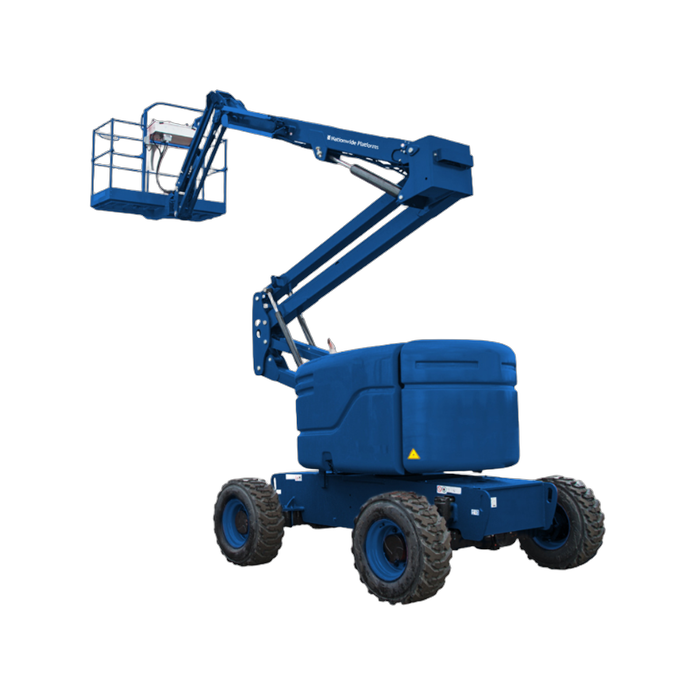
A knuckle boom lift - also called an articulating boom lift - is a self-propelled elevated work platform with multiple boom sections connected by articulating joints, allowing the platform to reach up, over and around obstacles that straight-boom and scissor lift designs cannot access. With construction, infrastructure maintenance and facility upgrades running at capacity across NSW, VIC and QLD in 2026, demand for articulating booms continues to grow.
This guide covers configuration, specification and cost variables for purchasing. Get quotes for knuckle boom lifts from verified Australian suppliers on IndustrySearch to compare pricing across brands and configurations.
Operations where knuckle boom lifts are the standard access solution:
- Commercial construction sites with steel framing, facade and services work
- Industrial facility maintenance - HVAC, overhead piping, structural steel
- Infrastructure projects - bridges, overpasses, utility corridors
- Shipyards and port maintenance operations
- Tree management and arboriculture on council and private land
Choose your configuration
Before costing anything, confirm which configuration suits your access requirements. Your choice here sets your price bracket and most of the specs that follow.
Type | Working Height | Best For |
|---|---|---|
Electric articulating boom | 10-20 m | Indoor facilities, warehouses, emissions-sensitive sites |
Diesel articulating boom | 12-40+ m | Outdoor construction, rough terrain, infrastructure |
Bi-energy (diesel/electric) | 12-20 m | Sites requiring both indoor and outdoor access |
Crawler/tracked articulating boom | 15-25 m | Soft ground, slopes, uneven terrain with limited hardstand |
If your work is primarily outdoors on construction or infrastructure sites with rough ground, choose a diesel 4WD unit. If more than 50% of your access is indoors or on slab, choose electric or bi-energy.
Electric articulating booms run quieter, produce zero on-site emissions and cost $30,000-$80,000 new. Battery runtime sits at 4-8 hours depending on duty cycle. They are the default for warehouse maintenance and any site with air quality restrictions.
Diesel articulating booms deliver full-day runtime without recharging, handle grades up to 45% and offer 4WD as standard on most models above 14 m. Prices range from $50,000-$150,000+ new.
Evaluate the key specifications
With your configuration confirmed, these are the specs that determine whether a given model fits your operation.
Specification | Typical Range | Buyer Consideration |
|---|---|---|
Working height | 10-43 m | Measure your highest access point and add 2-3 m clearance for safe platform positioning |
Horizontal outreach | 6-20 m | The distance the platform reaches sideways from the base - determines obstacle clearance |
Platform capacity | 200-300 kg | Must cover operator weight plus tools and materials. Two-person platforms need 250 kg minimum |
Stowed dimensions (L x W x H) | Varies by model | Check transport height against trailer regulations and doorway clearance |
Tail swing / zero tail swing | Zero to 1.2 m | Zero tail swing models are mandatory for confined site work near walls, traffic or other plant |
Gradeability | 25-45% | Construction and rural sites with uneven terrain need 30%+ gradeability |
Gross vehicle weight | 5,000-22,000 kg | Confirm floor loading for indoor use and trailer weight for transport |
The most common mistake is specifying working height alone without checking horizontal outreach. A 20 m knuckle boom with 12 m outreach can access work a 20 m telescopic boom cannot if an obstacle sits between the base and the access point. Always map both the vertical and horizontal envelope before selecting.
Understand the full cost breakdown (2026 prices)
Purchase price is only part of the picture - most cost models rejected at approval stage miss the running cost layer. Here is the full breakdown.
Category | Price Range (AUD) | Typical Configuration |
|---|---|---|
Entry-level electric (10-14 m) | $30,000-$55,000 | 2WD, battery-electric, 200 kg platform, zero tail swing |
Mid-range diesel (14-20 m) | $60,000-$100,000 | 4WD, diesel, 230 kg platform, rough terrain tyres |
High-spec diesel (20-43 m) | $100,000-$150,000+ | 4WD, diesel, 250-300 kg platform, jib boom, telematics |
Used / refurbished | $15,000-$70,000 | 5-10 year old units with current inspection. Price driven by hours and condition |
Annual maintenance | $2,000-$6,000 | Hydraulic service, filters, electrical system checks, tyre replacement |
Annual inspection (AS 1418.10) | $500-$1,500 | Competent person inspection. 10-year major assessment: $3,000-$8,000 |
Over 5 years, a mid-range diesel knuckle boom at $80,000 carries a total cost of ownership around $105,000-$115,000. At 200+ days of use per year, ownership breaks even against hire within 12-18 months. If you are within 6 weeks of purchasing, get quotes for knuckle boom lifts to lock in current pricing.
Plan the asset - depreciation and financing
ATO depreciation reference
The ATO effective life for elevated work platforms is 10 years. Diminishing value rate: 20%. Prime cost rate: 10%. The instant asset write-off threshold is $20,000 for businesses with aggregated turnover under $10 million. A $80,000 knuckle boom using diminishing value depreciates to approximately $26,000 residual at year 10.
Hire-to-own arrangements are common for operations where utilisation is unproven. Weekly hire rates sit at $800-$2,500 depending on platform height.
Evaluate suppliers
You are ready to go to market. Use this checklist to assess each supplier against the same criteria.
Factor | What to Ask |
|---|---|
Working height and outreach | Does this model reach your measured access envelope at full platform capacity? |
Power source options | Is a bi-energy or hybrid configuration available for mixed indoor/outdoor sites? |
Warranty terms | What is covered under warranty and for how long? Are structural components covered separately? |
Delivery lead time | What is the current lead time for your required configuration? Is stock held in Australia? |
Service network | Where is the nearest service centre to your primary operating location? |
Parts availability | Are hydraulic seals, filters and wear parts stocked locally or imported to order? |
Operator training | Does the supplier provide operator familiarisation at delivery? Is ongoing training available? |
Inspection and compliance support | Can the supplier coordinate annual AS 1418.10 inspections and 10-year major assessments? |
Compliance requirements
- Operators of boom-type EWPs above 11 m must hold a High Risk Work Licence (WP class) issued by the relevant state WHS regulator
- Annual competent person inspection required under AS 1418.10. A 10-year major inspection is required under AS 2550.10
- The PCBU must register the EWP as plant and maintain a plant register under state WHS legislation
- Safe Work Method Statements (SWMS) are required for all high-risk construction work involving EWPs
- Maximum operating wind speed for most models is 45 km/h - operations must cease above this threshold
Frequently asked questions
What platform height requires a high risk work licence for knuckle boom lifts in Australia?
Boom-type EWPs with a platform height exceeding 11 m require a WP class HRWL. Below 11 m, no HRWL is needed but the PCBU must still verify operator competency through documented training and assessment.
What is the typical 5-year total cost of owning a mid-range knuckle boom lift?
A mid-range 16 m diesel unit at $80,000 carries $25,000-$35,000 in running costs over 5 years, bringing total ownership to $105,000-$115,000. For a full pricing breakdown, see our knuckle boom lift price guide.
At what annual usage does purchasing a knuckle boom lift become cheaper than hiring?
Ownership typically beats hiring at 80-100+ days of use per year. Below that threshold, weekly hire at $800-$2,500 plus transport is usually more cost-effective.
When should I choose a knuckle boom lift over a scissor lift?
Choose a knuckle boom when access requires reaching up and over obstacles or positioning the platform horizontally away from the base. Scissor lifts are limited to vertical lift only and cannot clear obstructions.
What inspection schedule applies to owned knuckle boom lifts in Australia?
Annual competent person inspections under AS 1418.10 are mandatory, plus a 10-year major inspection under AS 2550.10. Daily pre-start checks by the operator are required before every shift.
What matters most
- Match configuration to environment: electric for indoor/slab, diesel 4WD for outdoor/rough terrain, bi-energy for mixed sites
- Specify both height and outreach: horizontal reach is the primary reason buyers choose a knuckle boom over other EWP types
- Budget for total cost of ownership: purchase price plus $5,000-$7,500/year in maintenance, inspections and consumables
- Verify licensing requirements: WP class HRWL for platform heights above 11 m - factor training costs and lead times into your timeline
- Prioritise local service support: hydraulic and electrical faults on site create immediate downtime - proximity to a service centre matters
Most buyers shortlist 2-3 models after getting an initial quote.
Don't waste time contacting suppliers individually. IndustrySearch gives you direct access to verified Australian knuckle boom lift suppliers - where industrial buyers request and compare multiple quotes so they can buy with confidence.
- Get quotes for knuckle boom lifts - contact multiple verified suppliers with a single enquiry
- Compare models - filter by capacity, configuration and region
- Contact suppliers directly - speak to specialists who service your state
? Get and compare knuckle boom lift quotes now ?




-160x160-state_article-rel-cat.png)