Key takeaways
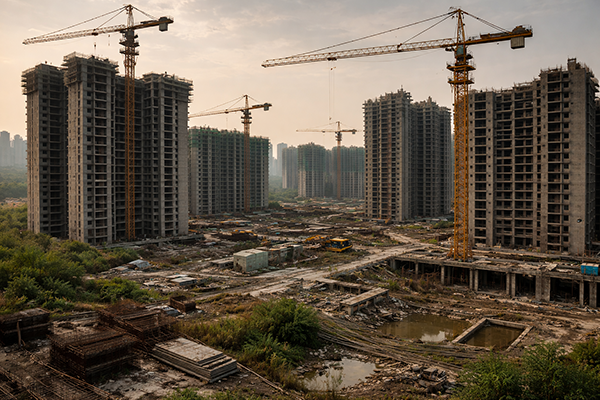
- China’s property downturn is structural, not cyclical. Housing starts and developer investment have fallen sharply since 2021, reducing demand for Australian iron ore, coking coal and related inputs.
- China still buys more than 70 percent of Australia’s iron ore exports, according to the Australian Bureau of Statistics. Your exposure to one market remains a material strategic risk.
- Bulk commodity volumes remain resilient, but price volatility is the new norm. Margins, not tonnage, are the core risk for suppliers.
- Decarbonisation and green steel policy in China are accelerating. Suppliers that can verify ESG credentials and emissions intensity will be favoured.
- Diversification across markets such as India and Southeast Asia, value-added processing, and stronger contract risk management should be on your agenda in 2026 and beyond.
Introduction: a structural shift, not just another cycle
For two decades, China’s property construction boom underpinned Australia’s export story. Apartment towers, transport infrastructure and industrial parks drove enormous demand for iron ore, metallurgical coal and base metals. For many Australian suppliers, China was not just a market. It was the market.
That era is changing.
China’s residential property sector has been contracting since 2021, with falling housing starts and developer investment. According to China’s National Bureau of Statistics, real estate investment has declined for multiple consecutive years. The impact has flowed directly into steel demand and, by extension, Australia’s bulk commodity exports.
In 2023-24, Australia exported over $136 billion worth of iron ore, with China accounting for roughly three quarters of that trade, according to the Australian Bureau of Statistics. That concentration risk is now front and centre for boards, CFOs and commercial managers across the mining and supply chain ecosystem.
Understanding the scale of exposure
China’s share of Australia’s bulk exports
China remains Australia’s largest trading partner by a wide margin. According to the Department of Foreign Affairs and Trade, China accounts for around one third of Australia’s total exports by value. In iron ore specifically, the reliance is even deeper.
Key exposure points include:
- Iron ore, where China typically takes more than 70 percent of export volumes
- Metallurgical coal, heavily tied to Chinese and broader Asian steel production
- LNG, where China is a major buyer alongside Japan and Korea
IBISWorld estimates that iron ore mining contributes more than $150 billion in annual industry revenue in peak years, making it one of Australia’s largest industries by value. When Chinese construction slows, it is not an abstract macro issue. It directly affects revenue forecasts, capex decisions and employment across Western Australia and Queensland.
What is actually changing in China?
China’s slowdown is driven by several structural factors:
- Developer deleveraging after years of high debt
- Demographic shifts, including a declining population
- Government policy aimed at stabilising rather than re-inflating the property sector
- A pivot towards advanced manufacturing and technology rather than property-led growth
Steel demand linked to residential construction is unlikely to return to previous highs. Infrastructure and manufacturing may partially offset this, but the composition of demand is evolving.
For Australian suppliers, this means your forward assumptions should reflect lower trend growth in Chinese steel intensity.
Price volatility becomes the primary risk
Volumes versus margins
One of the counterintuitive dynamics of recent years is that iron ore export volumes have remained relatively robust, even as Chinese property activity weakened. However, prices have been volatile.
The iron ore price peaked above US$200 per tonne in 2021 before retreating significantly. For producers with high fixed costs, price swings translate directly into margin compression.
From a financial management perspective, this shifts the focus to:
- Cost discipline and operational efficiency
- Hedging and pricing strategies
- Contract structures with offtake partners
- Balance sheet resilience
If you are supplying equipment, maintenance or logistics services to miners, your pipeline will increasingly depend on your clients’ cost positions. Low-cost producers remain active. Higher-cost operators may defer projects or reduce discretionary spend.
Practical example: contractor exposure in the Pilbara
Consider a mid-tier engineering contractor servicing iron ore operations in the Pilbara. During peak price cycles, miners expand aggressively, driving strong demand for shutdown services, new crushing circuits and infrastructure upgrades.
In a lower price environment:
- Expansion projects are deferred
- Maintenance intervals may be optimised
- Procurement teams push harder on rates
If you are that contractor, you need to demonstrate measurable productivity gains, digital integration and safety performance to remain preferred. Competing on price alone is not sustainable.
Diversification is no longer optional
Geographic diversification
The most discussed strategic response is market diversification. India is frequently cited as the next major steel growth market. Southeast Asia also shows strong urbanisation and infrastructure demand.
However, diversification is not straightforward:
- Logistics networks and shipping routes differ
- Product specifications may vary
- Political and regulatory risks must be assessed
- Existing long-term contracts with Chinese buyers may limit flexibility
The Australian Government has been encouraging trade diversification through agreements such as the Australia-India Economic Cooperation and Trade Agreement. According to the Department of Foreign Affairs and Trade, India’s economy is projected to be among the fastest growing major economies in coming years.
For suppliers, the question is whether you have:
- Market intelligence capability
- On-ground representation
- Flexible production and blending capacity
- Risk appetite for new counterparties
Product and value chain diversification
Beyond geography, you should assess whether you are overly concentrated in low value bulk supply.
Options may include:
- Moving further downstream into processing
- Investing in beneficiation to improve ore quality
- Expanding into critical minerals aligned with energy transition demand
Australia’s Critical Minerals Strategy highlights opportunities in lithium, rare earths and battery minerals. While these markets are also exposed to global volatility, they are tied to structural decarbonisation trends rather than residential property cycles.
ESG and green steel are reshaping buyer preferences
Emissions intensity matters
China has committed to peak carbon emissions before 2030 and achieve carbon neutrality before 2060. Steelmaking is one of its largest industrial emissions sources.
This has implications for Australian suppliers:
- High-grade iron ore is favoured because it lowers blast furnace emissions
- Buyers increasingly scrutinise Scope 1 and Scope 2 emissions of suppliers
- Transparency and reporting are becoming prerequisites for long-term contracts
Domestically, the Australian Government’s Safeguard Mechanism reforms place stricter emissions baselines on large facilities. If you operate a covered facility, your compliance costs and carbon management strategy will directly influence your competitiveness.
Compliance and reporting in Australia
Under the National Greenhouse and Energy Reporting framework administered by the Clean Energy Regulator, large emitters must report emissions and energy data annually. This data is increasingly used by investors and international buyers to benchmark performance.
If you cannot provide credible emissions data, you risk:
- Being excluded from premium supply chains
- Facing higher financing costs
- Losing access to ESG-linked capital
In practical terms, investing in emissions measurement, renewable energy integration and process optimisation is no longer a branding exercise. It is a commercial necessity.
Scenario planning for a structurally lower demand outlook
Recalibrating demand assumptions
If you are preparing a five-year strategic plan, your base case should not assume a return to peak Chinese construction intensity. Instead, scenario planning should include:
- Flat or modestly declining Chinese steel demand
- Periodic stimulus-driven price spikes
- Increasing competition from alternative suppliers such as Brazil
The Australian Bureau of Statistics data shows that mining accounts for around 14 percent of Australia’s GDP by industry share in recent years. A structural adjustment in export composition has macro implications.
Your board will expect rigorous stress testing of:
- Revenue sensitivity to price shocks
- Capital expenditure timing
- Dividend policy under lower price bands
Case study: capital discipline in practice
A large WA iron ore producer announces a new mine development. In the previous decade, such a project might have been justified on aggressive demand growth forecasts from China.
Today, the investment committee requires:
- Conservative long-term price assumptions
- Detailed ESG risk assessment
- Optionality in project staging
- Clear cost competitiveness against global peers
As a supplier bidding into that project, you must align your proposal with these constraints. Demonstrate lifecycle cost savings, emissions reductions and risk mitigation.
Supply chain resilience and contract risk
Lessons from recent disruptions
The past five years have highlighted the fragility of global supply chains. Trade tensions between Australia and China in 2020-21 affected several commodities. While iron ore remained largely insulated, other sectors were not.
You should examine:
- Counterparty concentration risk
- Contract enforceability across jurisdictions
- Exposure to sanctions or tariffs
- Insurance coverage and force majeure clauses
Robust contract management and legal structuring are now core commercial capabilities, not back-office functions.
Logistics and infrastructure constraints
Bulk commodity exports depend on efficient ports and rail networks. In Western Australia, port capacity and maintenance schedules directly influence shipment timing.
If Chinese demand becomes less predictable, inventory management and shipping flexibility become critical. Consider:
- Stockpile capacity
- Flexible shipping contracts
- Collaboration with port authorities
A minor disruption in a volatile pricing environment can materially affect realised revenue.
The domestic ripple effect
Employment and regional economies
Mining is a major employer in regional Australia. According to the Australian Bureau of Statistics, mining employs hundreds of thousands of Australians directly and indirectly.
If capital expenditure moderates due to lower Chinese demand:
- Regional contractors may face reduced pipelines
- Skilled labour markets may soften
- State royalty revenues may fluctuate
For suppliers embedded in regional ecosystems, diversification may also mean expanding into infrastructure, renewable energy or defence projects within Australia.
Government policy response
State and federal governments are aware of concentration risks. Policy initiatives often aim to:
- Encourage downstream processing
- Support critical minerals development
- Invest in domestic manufacturing capability
Keeping close to policy developments is not optional. Grants, tax incentives and regulatory shifts can materially alter project economics.
Practical steps you should take now
To position your business for a post building-binge environment, consider the following actions:
1. Conduct a revenue concentration audit
- Quantify direct and indirect exposure to Chinese property-linked demand
- Assess sensitivity to iron ore price bands
- Identify top three counterparties and their risk profiles
2. Stress test your cost base
- Model profitability at conservative price assumptions
- Benchmark operating costs against global peers
- Identify automation and digital optimisation opportunities
3. Strengthen ESG capability
- Ensure compliance with National Greenhouse and Energy Reporting requirements
- Set measurable emissions reduction targets
- Engage proactively with customers on decarbonisation alignment
4. Explore adjacent markets
- Assess entry barriers in India and Southeast Asia
- Evaluate feasibility of moving up the value chain
- Consider partnerships or joint ventures to share risk
5. Revisit capital allocation frameworks
- Prioritise projects with strong cost positions
- Stage investments to preserve optionality
- Maintain balance sheet flexibility
Conclusion: adapt to a new equilibrium
The end of China’s building binge does not mean the end of Australian resource exports. China remains a vast economy with significant industrial demand. However, the era of property-driven supercharged growth is unlikely to return in its previous form.
For Australian suppliers, the implications are clear. Concentration risk must be managed, cost competitiveness sharpened and ESG performance embedded into your commercial strategy.
You cannot control Chinese property policy. You can control how resilient, diversified and future-ready your business is.
If you treat this shift as a structural reset rather than a temporary downturn, you will make better strategic decisions. The companies that thrive in the next decade will be those that accept the new equilibrium and position themselves accordingly.



-160x160-state_article-rel-cat.png)
-160x160-state_article-rel-cat.png)