Key Takeaways
| Factor | Typical Range / Value | Buyer Implication |
|---|---|---|
| Price range (new, AUD 2026) | $12,000 – $35,000 | Mast height and reach mechanism set the price bracket |
| Lift capacity | 1,000 – 2,000 kg | Most warehouse pallets sit within 1,200–1,500 kg — match to your heaviest loaded pallet |
| Lift height | 3.0 – 5.5 m | Measure your highest racking beam — not the roof |
| Aisle width required | 2.2 – 2.8 m | Narrower than counterbalance forklifts — allows tighter racking layouts |
| Licence requirement | No HRWL required | Operator training still required under WHS Act 2011 |
| Reach mechanism | Pantograph or moving mast | Pantograph reaches into double-deep racking; moving mast suits single-deep |
| Annual maintenance | $800 – $2,500 | Lower than counterbalance forklifts — no LPG system, simpler hydraulics |
Why Australian Warehouses Are Adopting Walkie Reach Stackers
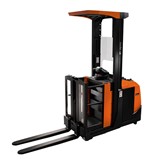
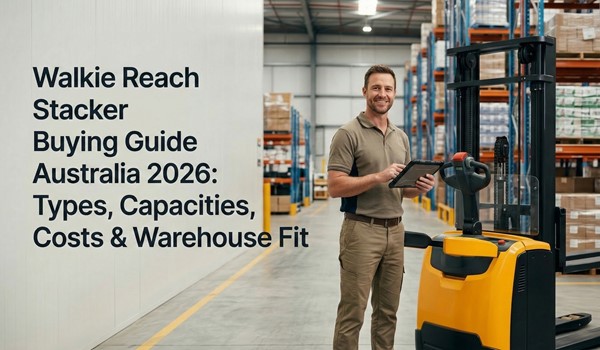
A walkie reach stacker is a pedestrian-operated electric stacker with a retractable mast or pantograph fork mechanism that extends forks beyond the straddle legs to place and retrieve pallets from racking. Australian warehouses, retail storerooms and 3PL operations are adopting them because they deliver racking access at heights up to 5.5 m without requiring a forklift licence — reducing both labour cost and operator bottlenecks in facilities where licensed drivers are in short supply.
This guide walks procurement and warehouse managers through the four decisions that determine the right walkie reach stacker: reach mechanism type, key specifications, full cost breakdown and supplier evaluation. Compare walkie reach stackers from verified Australian suppliers on IndustrySearch to benchmark pricing alongside this guide.
Walkie reach stackers are standard equipment across:
- Third-party logistics (3PL) warehouses with narrow aisle layouts
- Retail storerooms and back-of-house inventory management
- Cold storage and temperature-controlled distribution in VIC and QLD
- Manufacturing parts storage and staging areas
- Small-to-medium warehouses replacing counterbalance forklifts for racking work
Step 1: Choose Your Reach Mechanism
Before costing anything, confirm which reach mechanism suits your racking layout. Your choice here sets your price bracket and determines whether you can access single-deep or double-deep racking.
| Type | Key Feature | Best For |
|---|---|---|
| Moving mast | Entire mast tilts forward to extend forks | Single-deep racking, truck loading/unloading, general warehouse stacking |
| Pantograph (scissor reach) | Forks extend beyond straddle legs via scissor mechanism | Double-deep racking, narrow aisle work, maximising storage density |
| Counterbalance walkie stacker | No straddle legs — forks extend from front | Open pallets, mixed load sizes, areas where straddle legs cannot pass |
If your warehouse runs single-deep selective racking — a moving mast walkie reach stacker at $12,000–$20,000 handles standard pallet put-away and retrieval at heights up to 5.5 m without the complexity of a pantograph mechanism.
If you need double-deep racking access or want to maximise storage density in a narrow footprint — a pantograph model at $18,000–$35,000 is the correct choice. The scissor reach extends forks 600–800 mm beyond the straddle legs, placing pallets into the second position without repositioning the machine.
Step 2: Evaluate the Key Specifications
With your reach mechanism confirmed, these are the specs that determine whether a given model fits your warehouse layout and pallet profile.
| Specification | Typical Range | Buyer Consideration |
|---|---|---|
| Lift capacity | 1,000 – 2,000 kg | Capacity decreases at maximum height — check the rated capacity at your top racking beam, not floor level |
| Lift height | 3.0 – 5.5 m | Measure racking beam height plus pallet height plus 150 mm clearance |
| Aisle width | 2.2 – 2.8 m | Measure your narrowest aisle including racking uprights and pallet overhang |
| Fork length | 1,000 – 1,150 mm | Must match your standard pallet depth — CHEP pallets are 1,165 mm deep |
| Battery capacity | 24V 200Ah – 375Ah | Higher Ah rating extends shift coverage — lithium-ion available on premium models |
| Travel speed | 4 – 6 km/h | Auto-speed reduction at height is standard on quality units — improves stability |
Step 3: Understand the Full Cost Breakdown (2026 Prices)
Purchase price is only part of the picture — most cost models that get rejected at approval stage have missed the running cost layer. Here is the full breakdown.
| Category | Price Range (AUD) | Typical Configuration |
|---|---|---|
| New — moving mast | $12,000 – $20,000 | 1,500 kg capacity, 3.5–4.5 m lift, lead-acid battery |
| New — pantograph | $18,000 – $35,000 | 1,500 kg capacity, 4.5–5.5 m lift, power steering, side shift |
| Used / refurbished | $5,000 – $15,000 | Check mast chain wear, battery age and hydraulic condition |
| Annual maintenance | $800 – $2,500 | Mast chain lubrication, hydraulic fluid, battery maintenance, wheel replacement |
| Battery replacement | $1,200 – $4,000 | Lead-acid every 3–5 years; lithium-ion every 6–8 years |
| Hire rate | $110 – $250/week | Short-term hire for seasonal peaks or trial before purchase |
Five-year TCO on a mid-spec pantograph model sits at $24,000–$45,000 including purchase, maintenance and one battery replacement. By comparison, a counterbalance forklift doing the same racking work costs $50,000–$90,000 over five years including HRWL licensing, higher maintenance and greater energy consumption. For a 3PL warehouse in western Sydney or Melbourne’s south-east running narrow aisles, the walkie reach stacker pays back the investment within 12–18 months through recovered floor space and avoided forklift costs. Request quotes from walkie reach stacker suppliers on IndustrySearch to compare pricing across reach types and lift heights.
Step 4: Plan the Asset (Depreciation and Financing)
The ATO effective life for walkie stackers falls under “materials handling equipment — stackers, electric” at 10 years. The diminishing value depreciation rate is 20%; prime cost is 10% per annum. The instant asset write-off threshold for the 2025–26 financial year is $20,000 for eligible small businesses — most moving mast models and some entry-level pantograph units fall within this.
Residual value at 8–10 years on a well-maintained walkie reach stacker sits at 10–20% of new price. Hire-to-own arrangements at $140–$250 per week convert to ownership after 24–36 months on most mid-range models — a useful structure for operations still proving throughput volumes.
Step 5: Evaluate Suppliers
You are ready to go to market. Use this checklist to assess each supplier against the same criteria.
| Factor | What to Ask |
|---|---|
| Rated capacity at height | What is the rated capacity at your maximum racking beam height — not at floor level? |
| Reach mechanism | Moving mast or pantograph — and can the forks reach your deepest racking position? |
| Aisle width compatibility | Has the turning radius been validated against your narrowest aisle including pallet overhang? |
| Battery and charger | Is the charger included? Is lithium-ion available as an option? |
| Power steering | Is electric power steering included or optional? It reduces operator fatigue on long shifts. |
| Warranty coverage | What is covered (mast, hydraulics, electronics, battery) and for how long? |
| Service network | Do you have local service technicians and parts stock in my state? |
| Operator platform | Is a foldable ride-on platform available for reducing fatigue on long travel distances? |
| Safety features | Auto speed reduction at height, emergency stop, anti-rollback on ramps — are these standard? |
| Hire and trial | Can you trial the unit in your warehouse before committing? Is hire-to-own available? |
Frequently Asked Questions
How much does a walkie reach stacker cost in Australia?
New walkie reach stackers range from $12,000 for a basic moving mast model to $35,000 for a full-spec pantograph with power steering, side shift and lithium-ion battery. Used units start from $5,000 depending on age and mast condition.
What is the difference between a pantograph and a moving mast walkie reach stacker?
A pantograph uses a scissor mechanism to extend forks beyond the straddle legs — allowing access to double-deep racking. A moving mast tilts the entire mast forward, which works for single-deep racking but cannot reach a second pallet position.
Do I need a forklift licence to operate a walkie reach stacker?
No HRWL is required. Under the WHS Act 2011, the PCBU must provide documented operator training covering safe operation, load limits and emergency procedures. Training records must be maintained.
What aisle width does a walkie reach stacker need?
Most walkie reach stackers operate in aisles of 2.2–2.8 m — 30–40% narrower than a counterbalance forklift. Measure your aisle width including racking uprights and pallet overhang before selecting a model.
What is the expected lifespan of a walkie reach stacker?
A quality walkie reach stacker lasts 8–12 years in a commercial warehouse environment. The main wear items are batteries (3–5 years for lead-acid), mast chains and load wheels — all serviceable without replacing the machine.
Summary
- Pantograph models ($18,000–$35,000) access double-deep racking; moving mast models ($12,000–$20,000) suit single-deep
- Lift heights of 3.0–5.5 m cover most Australian warehouse racking configurations
- No forklift licence required — operator training under WHS Act 2011 is mandatory
- Aisle width of 2.2–2.8 m allows tighter racking layouts and recovered floor space
- Five-year TCO is 40–60% lower than a counterbalance forklift on equivalent racking tasks
- Always check rated capacity at your maximum lift height — not at floor level
Ready to Source Your Walkie Reach Stacker?
Don’t waste time contacting suppliers individually. IndustrySearch gives you direct access to verified Australian walkie reach stacker suppliers — compare models, specs and pricing in one place, then request quotes from suppliers best matched to your operation.
- Compare models — filter by capacity, configuration and region
- Request quotes — contact multiple verified suppliers with a single enquiry
- Contact suppliers directly — speak to specialists who service your state
→ Compare Walkie Reach Stackers on IndustrySearch Now →