Key takeaways
- Vague or incomplete quote requests for machinery can inflate total project costs by 5 to 15 percent once variations, delays and rework are factored in.
- In capital intensive sectors such as construction, manufacturing, mining services and agriculture, poorly scoped RFQs often lead to specification mismatches, compliance gaps and financing inefficiencies.
- According to the Australian Bureau of Statistics, equipment, plant and machinery consistently represent a significant share of private capital expenditure. Small procurement errors therefore have outsized financial consequences.
- A structured, compliance aware and lifecycle focused RFQ process can materially improve supplier response quality, reduce risk and strengthen your negotiating position.
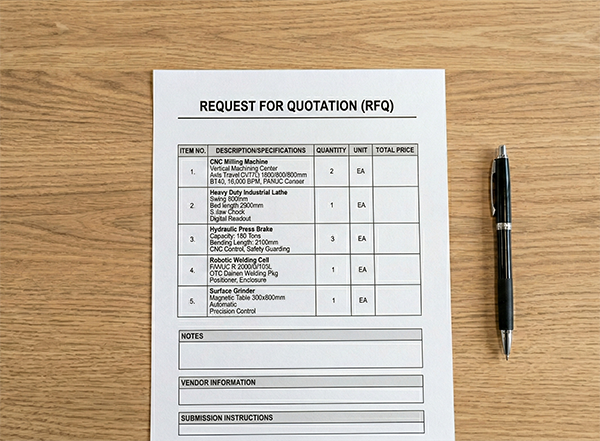
- Treat your quote request as a commercial document, not an email enquiry. The quality of inputs directly shapes the quality of outcomes.
Introduction
In Australia’s current operating environment, capital discipline matters more than ever. Input costs remain elevated, labour shortages persist across trades and technical roles, and project margins are under pressure.
Data from the Australian Bureau of Statistics shows that private new capital expenditure on equipment, plant and machinery runs into tens of billions of dollars annually. In industries such as construction, transport, manufacturing and mining services, machinery is not discretionary spend. It is the core productive asset base.
Yet one of the most common and costly mistakes businesses make is surprisingly basic: submitting poor quote requests when sourcing machinery or industrial equipment.
Below, we unpack the real cost of poorly constructed quote requests and outline a practical framework to fix the problem.
Why quote quality matters more in today’s Australian market
Rising capital intensity and margin pressure
Many Australian industries are becoming more capital intensive due to automation, safety requirements and productivity demands. For example, industry research from IBISWorld highlights increasing investment in automation and advanced machinery across manufacturing and logistics to offset wage growth and labour constraints.
At the same time:
- Construction businesses are navigating tight margins on fixed price contracts.
- Agricultural operators are managing climate variability and input cost volatility.
- Transport operators face fuel price swings and compliance obligations.
When margins are 5 to 10 percent, procurement inefficiencies can wipe out profit on a job or a quarter.
The compounding effect of small specification errors
A poorly drafted quote request might seem harmless. In reality, it can trigger:
- Incorrect machine sizing
- Under specified safety features
- Incompatible attachments or tooling
- Unrealistic delivery expectations
- Inaccurate freight assumptions
Each issue creates downstream cost, often through variations, retrofits or lost productivity.
The financial impact of vague or incomplete RFQs
Underquoting and post-award variations
One of the most common outcomes of a weak RFQ is inconsistent interpretation by suppliers.
If you request pricing for a “5-tonne excavator with standard bucket” without specifying:
- Required hydraulic flow
- Attachment compatibility
- Site access constraints
- Emissions standards
- Operator comfort or safety features
You will likely receive quotes that differ significantly in configuration.
Some suppliers may price a base model. Others may include optional inclusions. On paper, one appears cheaper. In practice, once you add missing components or rectify compliance gaps, the true cost escalates.
In commercial construction and engineering environments, variations can add 5 to 15 percent to project cost, particularly where equipment delays impact critical path scheduling. While precise national data on machinery related variations is limited, the broader cost of rework in Australian construction has been estimated in various industry reports as a significant share of project overruns.
Productivity losses and downtime
A misspecified machine may:
- Operate below optimal capacity
- Require additional units to meet output targets
- Experience premature wear due to mismatch with task profile
For example, consider a regional quarry operator that sources a wheel loader based solely on bucket capacity without specifying duty cycle intensity. The machine selected may struggle under continuous heavy load, leading to higher maintenance intervals and downtime.
If the site generates $50,000 per day in revenue and experiences two additional days of downtime per quarter, the annual opportunity cost quickly becomes material.
Compliance blind spots in Australian procurement
Work health and safety obligations
Machinery procurement in Australia is closely linked to work health and safety requirements.
Safe Work Australia and state regulators impose obligations relating to:
- Guarding
- Operator protection systems
- Noise exposure
- Electrical safety
- Emergency stop mechanisms
If your RFQ does not clearly require compliance with relevant Australian Standards or WHS regulations, you risk procuring equipment that requires modification before commissioning.
Retrofitting guarding or safety systems is typically more expensive than specifying them upfront.
Environmental and emissions requirements
In sectors such as construction and mining services, project specifications increasingly require adherence to environmental standards. This may include engine emission tiers or fuel efficiency criteria.
If you fail to specify emissions requirements, you may receive pricing on older or non compliant stock, particularly in secondary or imported markets. This can jeopardise eligibility for certain projects or government contracts.
The Australian Taxation Office also administers tax incentives and asset write off provisions that may depend on timing and classification. An unclear purchase structure can inadvertently compromise tax outcomes.
Information asymmetry and weakened negotiation leverage
Suppliers' price risk
When your RFQ lacks detail, suppliers price in uncertainty.
If they are unsure about:
- Site conditions
- Payment terms
- Delivery windows
- Installation responsibilities
- Training requirements
They may add contingency margin to protect themselves.
In contrast, a well-structured RFQ signals professionalism and reduces perceived risk. This often results in sharper pricing and clearer inclusions.
Apples versus oranges comparisons
Without a standardised specification template, you cannot effectively compare quotes.
You may end up reviewing:
- Different warranty periods
- Different service inclusions
- Different lead times
- Different freight assumptions
This creates internal confusion and increases the risk of selecting a supplier based solely on headline price.
In competitive tender environments, particularly in infrastructure related sectors, procurement discipline is a differentiator.
Real-world scenario: a mid-sized civil contractor in NSW
Consider a civil contractor in regional New South Wales preparing to tender for subdivision works.
The business submits a brief email request to three dealers for a 14 tonne excavator. The RFQ does not specify:
- Required auxiliary hydraulics for attachments
- Desired telematics capability
- Warranty expectations
- Operator cabin specification
- Finance structure
Dealer A quotes a base unit at $220,000.
Dealer B quotes a higher spec unit at $245,000.
Dealer C quotes $215,000 but excludes freight and commissioning.
The contractor selects Dealer C based on price.
Post award, they discover:
- Additional $12,000 for freight and pre-delivery
- $8,000 to retrofit hydraulic lines for attachments
- No telematics, requiring third-party installation
- Shorter warranty than competitors
The effective cost exceeds $240,000. The business also loses time during retrofitting, delaying mobilisation.
Had the contractor issued a structured RFQ with a clear specification schedule and comparison matrix, they could have identified the true value upfront.
How to fix it: building a structured RFQ process
1. Define operational requirements in detail
Before contacting suppliers, document:
- Primary application and duty cycle
- Operating hours per week
- Site conditions such as terrain and climate
- Required attachments or tooling
- Expected service intervals
Engage operators and maintenance managers early. They often identify practical requirements that procurement teams overlook.
2. Embed compliance and standards
Clearly state:
- Applicable Australian Standards
- WHS compliance requirements
- Emissions expectations
- Project specific obligations if relevant
Request written confirmation of compliance within the quote response.
3. Standardise commercial assumptions
Provide a structured template covering:
- Delivery location and timing
- Payment terms
- Installation and commissioning responsibilities
- Training inclusions
- Warranty period and coverage
- Service and maintenance packages
- Spare parts availability
This forces suppliers to respond on a comparable basis.
4. Evaluate total cost of ownership
Do not assess price alone. Instead, compare:
- Purchase price
- Estimated fuel consumption
- Maintenance intervals and parts pricing
- Resale value assumptions
- Downtime risk
Total cost of ownership modelling is particularly relevant in sectors identified by IBISWorld as facing structural cost pressure.
5. Align procurement with finance strategy
If you are financing the asset, involve your finance team early.
Consider:
- Chattel mortgage versus lease structures
- Residual values
- Impact on cash flow
- Debt covenant implications
Clear financial assumptions in your RFQ avoid rework once pricing is received.
Emerging trends reshaping quote requests
Digital procurement platforms
More Australian businesses are adopting digital procurement systems that standardise RFQs and automate comparison matrices. This reduces manual error and creates an auditable trail.
Data driven asset management
Telematics and IoT integration are increasingly standard in heavy machinery. If you fail to specify data integration requirements, you may miss opportunities to optimise fleet performance.
Sustainability and ESG considerations
Government and large corporate clients increasingly expect suppliers to demonstrate environmental responsibility. Your RFQ should reflect:
- Fuel efficiency targets
- Low emission technologies
- End of life recycling considerations
This aligns procurement with broader ESG strategy.
A practical RFQ checklist for Australian businesses
Before issuing your next machinery quote request, confirm that you have addressed:
- Clear technical specification
- Defined operational use case
- Compliance and safety requirements
- Delivery and commissioning details
- Warranty and service expectations
- Finance assumptions
- Evaluation criteria
Treat this document as a contractual precursor, not a casual enquiry.
Final thoughts: procurement discipline as a competitive advantage
In a market where private capital expenditure on equipment remains significant according to the Australian Bureau of Statistics, machinery procurement decisions shape your cost base for years.
Poor quote requests do not just create administrative friction. They:
- Distort pricing
- Increase compliance risk
- Inflate lifecycle costs
- Undermine operational efficiency
The solution is not complex, but it requires discipline. By investing time upfront in structured, compliant and commercially robust RFQs, you reduce uncertainty for suppliers and for your own team.
In competitive Australian industries, the businesses that manage capital expenditure rigorously are better positioned to protect margins, win tenders and scale sustainably.
The hidden cost of a weak quote request is real. The upside of fixing it is measurable.