-700x700-state_cat-rfq-thumbnail-test01.png)

Key takeaways
- Price range: New telehandlers in Australia cost $80,000-$300,000+ depending on lift capacity, reach height and brand (2026 pricing). Used units start from $45,000.
- Most common configuration: 3-3.5 tonne capacity with 7-10 m lift height accounts for the majority of Australian purchases across construction and agriculture.
- Attachment versatility: Forks, buckets, jibs, work platforms and bale grabs transform one machine into five. Specify hydraulic quick-hitch to maximise this advantage.
- Licensing: Telehandler operators require a High Risk Work Licence - LF class (forklift) for fork operations or CN class (non-slewing mobile crane) depending on configuration and state WHS interpretation.
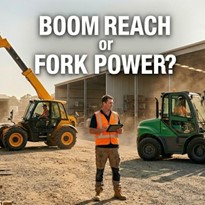
- If your primary task is lifting and placing loads at height with reach across uneven ground: specify a telehandler. If your task is repetitive forking on flat hardstand: an all terrain forklift is cheaper to buy and run.
- Annual maintenance: $3,000-$8,000 depending on hours, terrain severity and attachment usage.
Telehandler buying guide Australia 2026: How to choose the right telescopic handler for construction, agriculture and industry
A telehandler is a 4WD telescopic boom machine that lifts, reaches and places loads where conventional forklifts and cranes cannot. Australian construction, agriculture and industrial operations increasingly favour telehandlers because one machine with the right attachments replaces a forklift, a small crane and a loader on sites with rough terrain and variable reach requirements. With major infrastructure projects underway in NSW, VIC and QLD and agricultural operations investing in productivity, telehandler demand across Australia continues to grow in 2026.
This guide covers the configuration, specification and compliance factors you need to evaluate before purchasing. For pricing detail, see the telehandler price guide. To compare quotes from verified suppliers, get quotes for telehandlers on IndustrySearch.
Operations where telehandlers are standard equipment:
- Construction sites - material placement to upper floors, scaffolding supply, skip handling
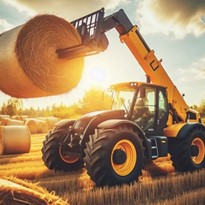
- Broadacre and livestock farms - hay bale stacking, feed-out, fence line logistics
- Industrial yards and logistics hubs - container handling, heavy pallet placement
- Mining support and civil earthworks - pipe handling, aggregate placement
Choose your configuration
Before costing anything, confirm which configuration suits your site and load requirements. Your choice here sets your price bracket and most of the specs that follow.
Type | Lift Capacity / Height | Best For |
|---|---|---|
Compact telehandler | 2.5-3 t / 6-7 m | Tight-access residential construction, small farms, indoor yards |
Mid-range telehandler | 3-4 t / 7-13 m | General construction, broadacre agriculture, logistics yards |
Heavy-duty telehandler | 4-6+ t / 10-18 m | Large construction, mining support, port operations |
Rotating telehandler | 3-5 t / 18-35 m | Multi-level construction, high-rise supply, complex placement tasks |
If your heaviest load is under 3 tonnes and your highest placement point is under 7 m, specify a compact unit. If you regularly place loads above 10 m or exceed 4 tonnes, a mid-range or heavy-duty model is required.
Compact telehandlers fit through standard site gates and work in spaces where larger machines cannot manoeuvre. They are the default choice for residential builders and smaller agricultural operations in Australia.
Mid-range telehandlers are the most commonly purchased tier. At 3-4 tonne capacity and 7-13 m reach, they cover the broadest range of construction and farming tasks with a single set of attachments.
Evaluate the key specifications
With your configuration confirmed, these are the specs that determine whether a given model fits your operation.
Specification | Typical Range | Buyer Consideration |
|---|---|---|
Maximum lift capacity | 2.5-6+ tonnes | Rated at ground level - capacity reduces at height and full extension. Check the load chart at your working height |
Maximum lift height | 6-35 m | Measure your highest placement point and add 1-2 m for safe positioning |
Forward reach at capacity | 3-18 m | Determines how far loads can be placed beyond the machine's footprint |
Transmission | Hydrostatic / powershift | Hydrostatic suits slow-speed precision work. Powershift suits higher travel speeds on larger sites |
Hydraulic flow (auxiliary) | 80-160 L/min | Higher flow required for rotating attachments, sweepers and bucket clamps |
Operating weight | 5,000-17,000 kg | Confirm transport weight for float trailer selection and site access load limits |
The most common mistake is specifying maximum lift capacity without checking the load chart at the actual working height and reach. A telehandler rated at 3.5 tonnes at ground level may only lift 1.0-1.5 tonnes at full boom extension - and overloading at height is a tipping risk that causes serious incidents on Australian sites every year.
Understand the full cost breakdown (2026 prices)
Purchase price is only part of the picture - most cost models rejected at approval stage miss the running cost layer. For full pricing detail across tiers, see the telehandler price guide.
Category | Price Range (AUD) | Typical Configuration |
|---|---|---|
Compact new (2.5-3 t) | $80,000-$130,000 | 6-7 m lift, 4WD, forks included |
Mid-range new (3-4 t) | $110,000-$180,000 | 7-13 m lift, 4WD/4WS, hydraulic quick-hitch |
Heavy-duty new (4-6+ t) | $180,000-$300,000+ | 10-18 m lift, load management system, telematics |
Used / refurbished | $45,000-$120,000 | 5-10 year old units with service history. Check boom pins, hydraulic seals |
Attachments | $3,000-$15,000 each | Buckets, jibs, work platforms, bale grabs, winches |
Annual maintenance | $3,000-$8,000 | Engine service, hydraulic fluid, boom chain, tyres, filters |
A mid-range telehandler at $140,000 running 1,200 hours per year carries a 5-year TCO of $170,000-$200,000. At that utilisation, ownership breaks even against hire within 12-18 months versus typical weekly hire at $2,000-$4,000. If you are within 8 weeks of purchasing, get quotes for telehandlers to benchmark current supplier pricing.
Plan the asset - depreciation and financing
ATO depreciation reference
ATO effective life for telehandlers: 10 years. Diminishing value rate: 20%. Prime cost rate: 10%. A $140,000 telehandler using diminishing value depreciates to approximately $46,000 residual at year 10. Chattel mortgage and hire purchase are the most common finance paths for telehandlers in Australia.
Evaluate suppliers
You are ready to go to market. Use this checklist to assess each supplier against the same criteria.
Factor | What to Ask |
|---|---|
Load chart at height | What is the rated capacity at your actual working height and reach? |
Attachment compatibility | Which attachments are compatible? Is the hydraulic quick-hitch universal or proprietary? |
Warranty | What is covered and for how long? Are boom and powertrain warranted separately? |
Service network | Where is the nearest service centre? Is mobile service available for regional sites? |
Parts availability | Are hydraulic seals, boom pins, tyres and filters held in Australian stock? |
Operator training | Does the supplier provide operator familiarisation at delivery? |
Delivery lead time | Is Australian stock available or is the unit imported to order? |
Load management system | Does the unit include a rated capacity indicator or load moment limiter? |
Compliance requirements
- Operators require a High Risk Work Licence - LF class (forklift) for fork operations. Some configurations may require a CN class (non-slewing mobile crane) depending on state WHS interpretation
- Telehandlers must comply with AS 2550.19 and AS 1418.19 for design, operation and maintenance
- Load management systems or rated capacity indicators are required on most models for safe operation at varying reach positions
- Work platform attachments used for personnel lifting must comply with AS 1418.10 and require separate annual inspection
Frequently asked questions
What licence do i need to operate a telehandler in Australia?
An LF class HRWL covers most telehandler fork operations. If the machine is used with a jib or winch for crane-type lifting, a CN class licence may be required - confirm with your state WHS regulator.
What is the typical 5-year total cost of owning a mid-range telehandler?
A mid-range 3.5 t unit at $140,000 carries $30,000-$60,000 in running costs over 5 years at 1,200 hours/year, bringing total ownership to $170,000-$200,000.
At what utilisation does purchasing beat hiring a telehandler?
Ownership typically breaks even against weekly hire at $2,000-$4,000 within 12-18 months at 1,000+ hours of annual use. Below 500 hours/year, hiring is usually more cost-effective.
What is the most common telehandler size purchased in Australia?
The 3-3.5 tonne, 7-10 m lift height range is the most popular tier. It covers the broadest spread of construction and agricultural tasks with a single set of attachments.
Can a telehandler replace a crane on a construction site?
For loads under 4 tonnes and heights under 18 m, a telehandler with a jib attachment can replace a small mobile crane at lower daily cost. Above these thresholds, a dedicated crane is required.
What matters most
- Check the load chart at height: ground-level capacity overstates what the machine lifts at full extension
- Specify hydraulic quick-hitch: maximises the attachment versatility that justifies the telehandler's premium over a forklift
- Match size to dominant task: 3-3.5 t / 7-10 m covers most Australian construction and farming applications
- Confirm licensing: LF class is standard but crane-type lifting may require CN class
- Budget for attachments: $3,000-$15,000 per attachment - factor this into the purchase approval
Most buyers shortlist 2-4 models after getting initial quotes.
Don't waste time contacting suppliers individually. IndustrySearch gives you direct access to verified Australian telehandler suppliers - where industrial buyers request and compare multiple quotes so they can buy with confidence.
- Get quotes for telehandlers - contact multiple verified suppliers with a single enquiry
- Compare models - filter by capacity, configuration and region
- Contact suppliers directly - speak to specialists who service your state
? Get and compare telehandler quotes now ?




-160x160-state_article-rel-cat.png)