Key Takeaways
| Factor | Typical Range / Value | Buyer Implication |
|---|---|---|
| Purchase price (new, AUD 2026) | $12,000 – $35,000 | Cheaper than adding floor space — recovers vertical storage capacity instead |
| Primary upgrade trigger | Racking above 2.5 m underused or inaccessible | If current equipment cannot reach upper beams, you are paying for storage you cannot use |
| ROI payback period | 6 – 18 months | Depends on recovered pallet positions and avoided lease/expansion costs |
| Aisle width saving | 30–40% narrower than counterbalance forklift | Tighter aisles mean more racking bays per square metre |
| No licence required | Training only under WHS Act 2011 | Any trained worker can operate — reduces labour bottlenecks |
| Lift height | 3.0 – 5.5 m | Covers most Australian warehouse racking configurations |
The Problem a Walkie Reach Stacker Solves
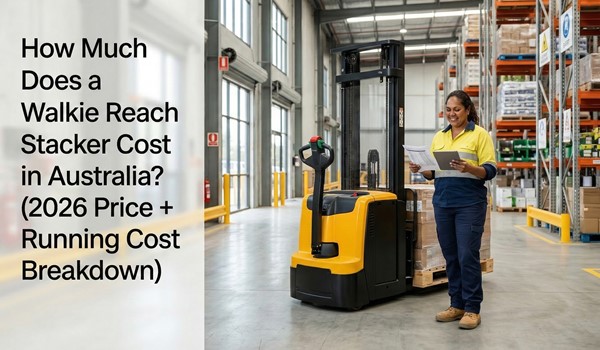
Most Australian warehouses hit a capacity ceiling before they run out of floor space — the bottleneck is vertical access, not horizontal area. Standard walkie stackers and pallet jacks top out at 2.0–2.5 m, leaving upper racking beams empty or accessible only by counterbalance forklift. A walkie reach stacker extends that access to 5.5 m without requiring a forklift licence, narrower aisles and at a fraction of the forklift’s cost and complexity.
This guide identifies the five warehouse signals that indicate it is time to upgrade from your current equipment to a walkie reach stacker — and quantifies the ROI for each trigger. Compare walkie reach stackers from verified Australian suppliers on IndustrySearch once you have confirmed the upgrade fits your layout.
This upgrade path is most common in:
- Growing 3PL and ecommerce warehouses where SKU count is outpacing floor space
- Retail chains consolidating back-of-house storage into fewer, denser storerooms
- Manufacturing operations expanding parts storage without facility expansion
- Cold storage facilities in VIC and QLD where every cubic metre is expensive
- Operations currently relying on counterbalance forklifts for racking tasks in mixed pedestrian zones
Step 1: Identify Your Upgrade Trigger
Before costing anything, confirm which of these triggers applies to your operation. Each one leads to a different ROI calculation and payback timeline.
| Trigger | What You Are Seeing | ROI Mechanism |
|---|---|---|
| Upper racking is empty | Beams above 2.5 m unused because current equipment cannot reach them | Each recovered pallet position avoids $800–$1,500/year in external storage or expansion cost |
| Licensed operators are a bottleneck | Racking tasks wait for the one or two forklift-licensed staff on shift | Any trained worker can operate a walkie reach stacker — eliminates the scheduling dependency |
| Aisles are too wide | Counterbalance forklifts need 3.5–4.0 m aisles, consuming floor space | Walkie reach stackers operate in 2.2–2.8 m aisles — freeing 20–30% more racking bays |
| Floor space is maxed out | Expansion or relocation is being discussed to handle growing pallet volumes | Vertical access + narrower aisles can recover 30–50% more pallet positions without moving |
| WHS incidents in mixed zones | Near-misses or incidents involving forklifts in areas shared with pedestrian workers | Pedestrian-operated walkie reach stackers eliminate forklift blind-spot and speed risks |
If your primary trigger is empty upper racking — count the unused pallet positions above 2.5 m, multiply by $800–$1,500 per position per year in avoided external storage cost, and compare that to the walkie reach stacker price ($12,000–$35,000). Most warehouses recover the investment within 6–12 months.
If your primary trigger is operator bottlenecks or aisle width — the ROI is harder to quantify in a single figure but shows up in reduced wait times, increased daily throughput and recovered floor space that delays or eliminates a facility expansion.
Step 2: Evaluate the Key Specifications for Your Layout
With your trigger confirmed, these specifications determine which walkie reach stacker model fits your existing warehouse layout without racking modifications.
| Specification | Typical Range | Buyer Consideration |
|---|---|---|
| Lift height | 3.0 – 5.5 m | Match to your highest racking beam plus pallet height plus 150 mm clearance |
| Lift capacity at height | 800 – 1,500 kg at max height | Capacity drops at full extension — confirm the spec at your actual racking height |
| Aisle width | 2.2 – 2.8 m | Measure including uprights and pallet overhang — if below 2.2 m you need a VNA truck |
| Reach type | Moving mast or pantograph | Pantograph needed for double-deep racking; moving mast suits single-deep |
| Floor condition | Smooth, level concrete | Floor joints, cracks and gradient affect stability at height — assess before purchase |
Step 3: Quantify the Cost and ROI (2026 Prices)
Purchase price is only part of the picture — most cost models that get rejected at approval stage have missed the running cost layer and the avoided cost on the other side of the equation.
| Category | Price Range (AUD) | Context |
|---|---|---|
| New walkie reach stacker | $12,000 – $35,000 | Moving mast at the lower end; pantograph with lithium-ion at the upper end |
| Used / refurbished | $5,000 – $15,000 | Suitable for trial or lower-volume operations |
| Avoided external storage | $800 – $1,500 per pallet position/year | Recovering 20 positions saves $16,000–$30,000/year |
| Avoided facility expansion | $150 – $350 per m²/year (lease) | Recovering 50 m² of aisle space saves $7,500–$17,500/year |
| Annual running cost | $1,500 – $4,000 | Maintenance, energy and consumables |
For a warehouse in western Sydney recovering 20 unused pallet positions above 2.5 m, the avoided external storage cost alone ($16,000–$30,000/year) pays for a mid-range walkie reach stacker ($20,000–$28,000) within 12 months. The narrower aisle benefit stacks on top of that. Request quotes from walkie reach stacker suppliers on IndustrySearch to build your specific ROI case.
Step 4: Plan the Asset (Depreciation and Financing)
The ATO effective life for electric walkie stackers is 10 years. Under diminishing value, the depreciation rate is 20%; prime cost is 10% per annum. The instant asset write-off threshold for 2025–26 is $20,000 for eligible small businesses. Hire-to-own at $140–$250 per week converts to ownership after 24–36 months — a structure that aligns the cost with the ROI timeline for operations still validating throughput volumes.
Step 5: Evaluate Suppliers
You are ready to go to market. Use this checklist to assess each supplier against the same criteria.
| Factor | What to Ask |
|---|---|
| Warehouse trial | Can the supplier trial the unit in your actual racking layout before purchase? |
| Capacity at height | What is the rated load at your specific racking beam height? |
| Aisle validation | Has the supplier confirmed the turning radius fits your narrowest aisle? |
| Reach type | Moving mast or pantograph — and does it access your racking depth? |
| Battery and charger | Included in price? Lithium-ion option available? |
| Warranty | Coverage period and components included? |
| Service network | Local service and parts availability in your state? |
| Training | Operator training included and WHS-compliant documentation provided? |
| Finance | Hire-to-own, chattel mortgage or operating lease available? |
| Upgrade path | If you outgrow this unit, does the supplier offer trade-in or upgrade to ride-on reach trucks? |
Frequently Asked Questions
At what pallet volume does upgrading to a walkie reach stacker make financial sense?
If you have 15 or more pallet positions above 2.5 m that are currently inaccessible, the avoided external storage cost ($12,000–$22,500/year) exceeds the annual cost of owning the stacker within the first year.
Can a walkie reach stacker replace a counterbalance forklift?
For racking tasks up to 5.5 m in narrow aisles, yes. For dock loading, outdoor work on rough surfaces or lifting above 2,000 kg, no — the forklift remains the correct machine for those tasks.
How long does the upgrade payback take?
Six to eighteen months depending on the number of recovered pallet positions and avoided storage or expansion costs. Warehouses with high external storage costs or imminent lease renewals see the fastest payback.
Do I need to modify my racking for a walkie reach stacker?
Typically no — walkie reach stackers are designed to work with standard Australian pallet racking (CHEP-compatible). Confirm the machine’s straddle leg width clears your racking uprights and that the floor is smooth and level.
What is the biggest risk of delaying the upgrade?
Every month of inaccessible upper racking is a month of paying for storage capacity you already own but cannot use. For a 20-position gap, that costs $1,300–$2,500/month in avoided external storage alone.
Summary
- The primary upgrade trigger is inaccessible upper racking — if beams above 2.5 m are empty, you are paying for storage you cannot use
- Walkie reach stackers at $12,000–$35,000 pay back within 6–18 months through recovered pallet positions
- Narrower aisles (2.2–2.8 m) recover 20–30% more racking bays per square metre
- No HRWL required — eliminates operator bottlenecks and scheduling dependency
- Pedestrian operation reduces WHS risk in shared-traffic warehouse zones
- Count your inaccessible pallet positions above 2.5 m — that number is your ROI calculation starting point
Ready to Source Your Walkie Reach Stacker?
Don’t waste time contacting suppliers individually. IndustrySearch gives you direct access to verified Australian walkie reach stacker suppliers — compare models, specs and pricing in one place, then request quotes from suppliers best matched to your operation.
- Compare models — filter by capacity, configuration and region
- Request quotes — contact multiple verified suppliers with a single enquiry
- Contact suppliers directly — speak to specialists who service your state
→ Compare Walkie Reach Stackers on IndustrySearch Now →

-160x160-state_article-rel-cat.png)
-160x160-state_article-rel-cat.png)

-160x160-state_article-rel-cat.png)


-160x160-state_article-rel-cat.png)